Oddly, I think the article underestimates the size of the change coming. I think one side affect of the surge of IT into advertising, is that it has become easier to measure exactly how well advertising works. By and large, it doesn't, very well.
"...The reason Yahoo didn't care about a technique that extracted the full value of traffic was that advertisers were already overpaying for it. If Yahoo merely extracted the actual value, they'd have made less."
I'm pretty sure that, the more we learn about how well advertising works, the less money people will be willing to pay for it. What's happening to billboards and newspapers right now is probably coming to several other industries soon.
I know Twitter isn't known for being the best at advertising, but it was made exceptionally clear to me that online advertising is a massive bunch of lies when I did my GDPR Twitter data export and it included me in a bunch of incorrect, non-sensical and contradictory ad targeting groups.
Twitter claims I:
    * Own a cat, dog and other animal (I don't)
    * Have between $100k- $999k liquid investible assets (I don't)
    * Have a net worth between $1 and $1m (cool - I own *something*)
    * Am highly affluent (/shrug)
    * Am a high spender (okay...)
    * Am a frugal spender  (...but how can I be both a high spender AND frugal)
    * Own a house (I don't)
    * Have multiple families (I don't)
I was very disappointed that the Google and Facebook data exports don't contain this data. Maybe it's for their best.
> GDPR Twitter data export and it included me in a bunch of incorrect, non-sensical and contradictory ad targeting groups.
This is expected. It's not desirable, but it is expected.
The problem is your comparing it to an absolute. I.e. to perfect.
If advertisers had that choice, they would love it. They generally don't. Remarketing is kinda close, but limits the scale.
Rather, the only other scalable options are far worse. Think about it. What are the marketers other choices?
The one that should come to mind, and the one they spend most of their money: TV.
With TV you pick up a huge amount of waste. Say you buy a spot on Big Bang because you want people thinking of buying a new iPhone. Not a big stretch, right? At the same time thinking of all the other people they have to buy, who watch the ad, and aren't buying an iPhone. It's waste.
And that waste is huge relative to what you're talking about above.
So you're asking the wrong question here. It's not how good is the targeting in terms of precision/recall. The question is what's better?
The waste here is generally known & its priced accordingly.
> I was very disappointed that the Google and Facebook data exports don't contain this data.
It's in my Facebook export. Under "Information About You" did you uncheck "Ads"?
That's where the information is contained & it's checked by default.
You can also view it here for both FB & Google, as well as opt of both:
> Rather, the only other scalable options are far worse.
Is it really worse than "this article is about X, Y is related, let's show some ads for Y"?
I bet from the point of view of the advertisement middlemen it is not. Because they capitalize mostly on showing ads of products that people already decided to buy or are very near deciding. But that is yet another racquet that only decreases the value of the industry. My question is, from the point of view of the real advertisers (the ones selling something), is it really worse?
Right but the advertising budgets for things actually related to articles or other media content are vastly dwarfed by the advertising budgets for unrelated things that actually make more revenue/profit.
So you'll end up having to try to monetize something that has little no no related things that are profitable to advertise.
> Advertise on a dog community site is probably pretty spot on if you want to target dog owners...
That would probably target dog enthusiasts or dog hobbyists or dog fanatics, which are all subsets of dog owners.
I think that one of the things that makes social media ad targeting so attractive to advertisers is that they can target the dog owners, instead of just the enthusiasts/hobbyists/fanatics.
> Advertise on a dog community site is probably pretty spot on if you want to target dog owners...
Big brands struggle with UGC. Witness the events of YouTube & brand safety.
But even without that, what you're saying just isn't scalable. What community site can reach even 50% of dog owners -- let alone what a primtetime sitcom or YouTube can reach?
> No, advertisements like that are more about selling the brand than selling iphones. Something TV is probably pretty good for.
What? Sure, they have campaigns running for awareness, recall, perception.
But you're really saying Apple doesn't dramatically increase its spend when a new phone is released? That's poppycock.
Only google et al cares about scalability, everyone else cares about results. Only google needs to sell ads without any knowledge about the product or audience, this scales extremely well but leads to poor results.
> But you're really saying Apple doesn't dramatically increase its spend when a new phone is released? That's poppycock.
When is the best time to sell the brand? When your flagship is a year old and still costs as much as on launch day and when the competition has surpassed you? Hardly.
People that has enough interest to use a dog-forum has too much knowledge of quality to buy things that a company advertises. They will know already what works for their dog and does not listen to advertising in the normal sense. They might however listen to bloggers that has been payed to talk about brands.
If you buy ads, you want them displayed to the non-fanatics that is not influenced by experience and vulnerable to brand exposure.
As long as the algorithms are close to or better than this model why would they bother? One is all automated and the other is a lot of work dealing with individual websites (even if it is just a matter of manual targeting settings)
Looking at the hundreds of mostly incorrect or irrelevant demographics that Twitter has be in, I would still say there’s a huge amount of waste going on. At least with offline advertising (like TV or print) the “fuzziness” is very explicit. Here, Twitter sells you that you can target “dog owners”, but nowhere through the Twitter ad buy process does it tell you how BS that targeting is.
And that's why Twitter is not doing as well as Facebook. Facebook doesn't need algorithms to know what you are interested in, where you like to eat, etc. You explicitly tell them in your info and by what types of articles you like and share, and what you post.
Well I’ve told Twitter that I hate Blockchain and think it’s all BS, yet I still get ads for ICOs and “Uber for the blockchain” - whatever the fuck that is.
Again, I guess this is because Twitter sucks at advertising.
Twitter is the same, except even more-so. People tweet 10+ times a day, update FB status infrequently.
All the things FB has done to extract things like resturant data etc are product development they undertook. Twitter spent 10 years moving form 140 characters to 280 instead.
Even if that is true, when people sign up for Facebook, they fill out a bio telling FB their work history, their school affiliations, who their family members are, their hometowns and current cities, they check in where they are at, tell FB their favorite books, music, tv shows, thier gender, relationship status, thier sexual preference, and thier political party affiliation. Everyone doesn't fill out everything, but a lot of people do.
Plus the fact that they can also average your interests from information volunteered by your friends and family because "birds of a feather, flock together".
IOW, Twitter followers may be total strangers to many IRL, unlike Facebook followers.
Traditionally, it wasn't necessarily considered a waste to give people a positive feeling about your brand even if they weren't the specific ones who wanted to buy, because everybody talks to everyone else.
I think advertisers have been chasing a chimera via targeting, because not only doesn't it work well, but there is a trade-off to maintaining a brand.
I’ll tell you one thing that’d be better: prices and wages that make sense. I shouldn’t be faced with dozens of subscriptions just to lead basically the same life I did over a decade ago with half those subscriptions (or fewer). And being paid 5x what I made then shouldn’t feel like I’m making it work but not saving much. And I shouldn’t be getting sales calls over 4 months after having used TrueCar.
For the frugal/high spender conflict, I can kind of see how that might happen.
I try to buy quality goods because cheap stuff doesn't last. That means spending more up front to spend less in the long run. So frugal, but also maybe high spender?
My mom always says: if you're poor, you can't afford to buy cheap.
All things equal (features that I need from the product) I like to buy high quality things because they make me feel good (they look well built, they give me this warm feeling inside that I got my money's worth). But I realize this is all emotional and rationally I shouldn't, in most cases.
I don't think they pay off long term, at least it seems heavily dependent on the product type. That's because we are playing a lottery game, even if this product breaks in 0.1% cases vs 5% cases for a much cheaper product, we're not buying large numbers of them, we're buying just one and while the probability to break on me is smaller it can still happen and the monetary loss would be much larger than if I were to buy the cheaper product. That is, the warranty doesn't scale with the price (the expensive top quality TV is $2000 and the cheaper one is $500 and both have 1 year of warranty), for the same money I can buy 4 of those $500 TVs and would last at least 4 years (but very likely to find at least one that will work much longer, since I'm buying up to 4 of them).
That almost never works for the reason you describe. For any quality item that lasts M times as long as the cheap item, you can almost always find N > M such that you can buy N copies of the cheap item for the price of one quality item. You do not spend less in the long run, though you can convince yourself of that. The primary effect of buying cheap is not financial, it's that you're dealing with less quality over the entire usage lifetime (hence getting less utility out of it) and the replacement effort has cost (but which for poor people is very little by definition).
It is probably because they have to show you the categories/tags but they are not required to show you the exact percentage/probability. So in their db they have it like 80% frugal spender, 15% high spender but when exported you see it as a yes/no which is confusing.
I guess the 'spoiler' is that I'm fortunate enough to certainly not be a frugal spender. Yet another data point they have about me that they sell, but is completely incorrect.
The math can work out in some cases. I've had my 400$ Allen Edmunds for 8 years, some wear, but generally still in fantastic shape and very comfortable. Prior to getting them I bought 1-3 pairs of ~70$ department store shoes per year.
Usually it's very anecdotal and hard to tell ahead of time. My current shoes cost 40€ and that was about 4 years ago. So they have lasted atleast half as long as your expensive shows for 1/10th the price.
I have some inexpensive Chinese-made boots that are over a decade old, I think. It can't be the norm that shoes last 4 months, unless you are talking about wearing down the soles of running shoes.
    * Your age bracket;
    * The fact that your net worth is positive (not deep in debt);
    * Whether you live in a city / suburb / countryside;
    * Which part of country is that;
    * Your gender;
    * Your race / ethnicity, broadly?
If so, they still have an immensely precise focus on you, compared to TV, radio, or paper media, even if they're mistaken about your cat.
Yep agreed. As a salesperson, knowing someone went to college is often more helpful than knowing what exact college someone went to - too personalized is just creepy. I think the trick is somewhere around the space being able to accurately engage someone with of "hey you look like the sort of person who might be interested in xyz".
Yeah, my impression is that this whole "smart, targeted ads" thing is actually just a lie, and that it's really more of a "spray and pray" kind of thing.
But everyone using this spray and pray knows it is far from perfect. You just use the best you can get and knows about the imperfections. Spray and pray also works in a broad sense.
The idea of advertising is also to create interest where there is none. If you all of a sudden see an ad about those other topics your aren't super interested yet, maybe you will become. That's the idea of manipulation and marketing.
Most of the topics Google thinks I'm interested in are close enough. But American football and Parenting? I don't know where they got those. I have to consciously think to come up with the name of the local team ("Mariners? No, that's baseball."), and we don't have kids nor any plans to do so.
Maybe it was all the clicking on CafeMom.com (mommy blog with tons of trackers and ads) while I was testing the Pi-Hole set up. :-)
But interesting page. Looking at the "advertisers who have added your details to their targeting list" it again shows how bullshit this industry is:
    * Playstation in 19 countries
    * Musicians which I definitely don't listen to, like Keith Urban, Post Malone, Jack White, YBN Nahmir, and Ziggy Marley, whoever these people are.
    * Pages like "Top Kickstarter Watches" and "Top Kickstarter Inventions"
    * A bunch of restaurants that I've never been to, but are in the same complex that I used to live in (thanks whoever sold/'shared' my email, literally probably my former real estate agent)
One can see it a bit like search where it can be more important to do fast exclude than to have correct include. Those 8 ad targeting groups are potential matches, but what the data do not say is the hundreds of targeting groups which twitter claim that you are not. This kind of fast classification is good as a performance/cost saving technique when the error cost is also low.
Also, one can be high spender and frugal. A person who buy one pair of very expensive shoes and wear them for 10 years rather than buying 10 pairs of inexpensive ones would be such person.
Those are just arbitrary names given to clusters of users. If your behavior and responsiveness is similar to others in the group, why should the advertiser care if the label isn't literally true?
If that's true, it's not because ad tech doesn't work, it's that most advertisers don't use it properly. A large percentage of my company's revenue comes from performance marketing (running paid traffic to affiliate offers) and it works very well for us. You just have to know what you're doing, make sure you're not getting too much bot/junk traffic, and bid the appropriate amounts. We've written software that handles all of this automatically, and our paid traffic campaigns do amazingly well. Show me another investment in which you can reliably and consistently achieve 30%+ ROI weekly with a fair amount of scalability.
Ironically, native ad networks like Taboola and Revcontent will flourish in the new GDPR world. Since they target ads based mostly on nothing more than the topic of the content that the user is viewing, these ads are effective enough for smart performance marketers to make money with, and GDPR doesn't fundamentally change anything about their model. EU advertisers will flock to native and abandon other forms of advertising that were based on more invasive targeting.
I’m not sure what you mean by that. But generally we get about a 30-50% ROI on our native ad campaigns once they are optimized, and most affiliate networks pay weekly if you produce significant revenue. We do better than most because I wrote some clever stuff to identify sites that were sending us mostly bots/bad traffic and automatically blacklist them from showing our ads. There are a ton of these in the native ad space.
I just suspect most of the trick is in generating demand, not finding it.
There are evergreen affiliate niches such as weight loss, hair loss, erectile dysfunction, etc. Aging, bad genetics, and poor lifestyle choices generate the demand for us. Making money in these niches is generally as simple as placing ads on sites where people that belong to certain known demographic groups visit, and reducing fraudulent traffic by as much as possible.
How do you measure the 30%? Compared to previous revenue or compared to a cohort you purposely don't advertise to, but is randomly selected from those you do?
That said, the niches you describe sounds like snake oil markets. :(
If true, it makes a very amusing reversal from the usual story. Rather than peddling their wares to suckers, the placers of the ads have themselves been suckered into buying a product that doesn't work as advertised!
The more you think of it, the more it seems to be totally expected. It's the advertising industry we're talking about. They're not exactly a paragon of honesty. On the contrary, I suspect everyone tries to bullshit everyone else. The few observations I made from working next to people in marketing & advertising supports that viewpoint.
EDIT: reminds me of that one story about A/B testing, which pretty much directly told us how adtech companies are bullshitting their own customers.
In it E. Ann Hollier and Tim Ambler make a strong case for what has been known from the start about branding: that mass media do it best, without performing at the personal levewl. One corollary for their case might be, "Not everything you value can be measured, and not everything you can measure has value."
Because digital advertising can be both targeted and measured, the whole advertising business decided that ads perform only when they are targeted and measured. But that's not advertising, really. That's direct marketing, which -- as I say in that post -- is descended from junk mail and a cousin of spam.
It's no accident that the $trillion or more spent on adtech hasn't produced a single brand known to the world.
The unanswered question is the one raised in The Problem With Targeting (https://www.dotcoma.it/2015/06/22/the-problem-with-targeting...), and pretty much everything Don Marti and Bof Hoffman (look them up) have been writing as well: is it possible for online advertising to brand products the way offline print and broadcast media could, and still do?
I suspect the answer is no. But my mind is open on the matter.
* Time and resource intensive prebiased word of mouth has a higher conversion rate.
* Conversion rates for mass advertising are very low numbers.
It is also easy to provide numbers for:
* Conversion rates for targeted advertising are significantly higher than non-targeted advertising.
* Having a non-existent marketing strategy for scale markets has a high probability of failure.
What is your position exactly?
Consider also some of what is implied throughout the article, that changes implied may price smaller companies out of the market. This doesn't bode well for competition, particularly for less funded competition. Small p&l organizations typically need to market to drive revenue, they're rarely in a position to push brand marketing strategies alone. Indeed this is a common huge difference between fine and coarse targeted platforms - when did you last see a small p&l trying to advertise on cable? What about on fine target platforms such as Facebook? Do you want such companies to become competitors to brand giants?
There are three main kinds of ads I see: (1) products I just bought, (2) products I would never ever buy, and (3) creepily manipulative clickbait. None of these should be worth the money to the advertiser.
I test drove a car and after I got almost a dozen follow up calls while I was busy with other stuff, I blocked the dealership number. They kept calling me from other numbers, which I also blocked (with the new Android spam filter on my phone). But the amusing thing was that I started seeing ads for the dealership online promoting their "low pressure" sales team!
I made fun of a company called Salsify for naming their business after oyster plant, a root vegetable I can't stand, and now I see ads for them all the time.
> I'm pretty sure that, the more we learn about how well advertising works, the less money people will be willing to pay for it.
That sounds like a statement from someone not very familiar with advertising.
Minimally it's contrary to the agency model & its incentives. A lot spend (the majority?) goes through that model, and it's not likely to change any time soon. And if anything GDPR, will increase it.
That said, even as measurement & attribution improves, the reality is that the effect will be shift to spend around. The better an advertiser can identify waste, they better they can redeploy that spend. Because that improves the ROI, the less it hurts the margin, and the more it makes sense for them to spend.
>I think one side affect of the surge of IT into advertising, is that it has become easier to measure exactly how well advertising works. By and large, it doesn't, very well.
If that was true, Coca-Cola and McDonald's wouldn't exist.
Coke's most successful marketing trick was a giant fluke. Even then, most of their success is probably in cornering the market, not just marketing. In large, many (most?) places sell it because they have an exclusive license that provides cups and supplies.
McDonald's is a funny one. They really don't seem any worse than most other fast food to me. I suspect they saw more expansion from their franchise methods than anything else, though.
Which is not to say the marketing isn't important. I just don't think it deserves the full victory.
Then I contend that marketing is expanded to too large a term. And at that point, yes, it is responsible from everything including product strategy, but also worthless as a term. :(
Might as well debate that "business" is responsible.
Especially if the success is not repeatable. Which, most early practices of large companies today are not repeatable by smaller companies.
Marketing has always been defined by the 4P's: Product, Price, Place, and Promotion.
The "business" defines the problem-space and strategic direction (in these cases, food/drink), marketing defines how you address the space (specifics of the products from research and evaluation, market positioning, promotion to audiences), operations executes on the above (supply chain, training, maintenance), and then customer support feeds into all three of the above.
Advertising is a subset of marketing, but marketing is a broad term, and is often mistakenly limited in how it's used in arguments (usually to belittle the role of it).
That still seems to broad of a definition. I get that it is taught to be concerned with the 4Ps, but those can clearly exist independent of a marketing department. Or any discernible marketing strategy.
Consider, as well, that the engineering department is also responsible for the Product. In large, they are also influential in the Price. Yet, I think it would also be unfair to give engineering full credit for a successful product. Even if it was well engineered or poorly marketed.
Which is to further my point that I was not trying to dismiss marketing as a valid area that a company should invest in. I just don't think it should deserve full credit for Coke and McDonald's existing. :)
underestimates or overestimates? There is advertising that doesn't require tracking. Simple brand-awareness-building and content-based advertising is pretty profitable without requiring tracking. For a website, the lack of personally-targeted ads may be offset by increasing the number of ad slots. I wonder if there is an estimate on how much value tracking adds.
There is no reason to expect that ad spending will drop in total, because ads never worked very well in any medium, but they worked well enough that it's worth investing in them. The portion of ad spending in TV has not changed significantly the past decades, what has happened is spending has shifted from newspapers to online. but the overall the volume keeps increasing in all media
Oddly, I think YOU are underestimating the size of the change coming, too. An upended industry won't go quietly, and I think we're about to see a lot of technology innovation to circumvent the new wave of privacy restrictions.
I think you're missing the point that's being made in the parent post. It's not that enhanced privacy will cause advertising to implode, it's that as the industry has gained more knowledge and understanding of advertising it's becoming apparent that advertising isn't worth what they thought it was.
I saw a similar up-ending of an ad-dependent industry 15 years ago with newspapers. Advertisers for years assumed a certain value based on the circulation numbers as reported by ABC. There was no real way to directly measure that value other than inferred activity within a geographic region that could arguably be tied to newspaper advertising. With the internet advertisers began to be able to track specific value for ad campaigns based on click-thrus, cost-per-action, etc. Those values were lower than the assumed value of newspaper advertising, which began a shift in where money was spent. Combine that with the fact that ABC numbers started to show that they were far less accurate than originally assumed, due in part to gaming by the papers themselves, and revenue started seriously shrinking. The last firewall that newspaper had was classified, which quickly folded in the face of job and real estate sites and of course craigslist.
Internet advertising has been suffering the same game-playing by sites that newspapers pulled with ABC circ numbers, and as advertisers gather more and better performance data about the value of ads and campaigns they're realizing that value is less than they thought and seems to be trending down.
Regardless of whether there's more or less privacy for users/consumers, the indications are that advertising is becoming less and less valuable.
advertising has never worked, but the delusion that it could work is strong - it seems like there’s probably a neverending supply of businesses who are going to throw some money down the drain, just in case they get lucky. It’s like buying lottery tickets - you don’t do it because of your great ROI, you do it because you’re having a fantasy about results
> I'm pretty sure that, the more we learn about how well advertising works, the less money people will be willing to pay for it. What's happening to billboards and newspapers right now is probably coming to several other industries soon.
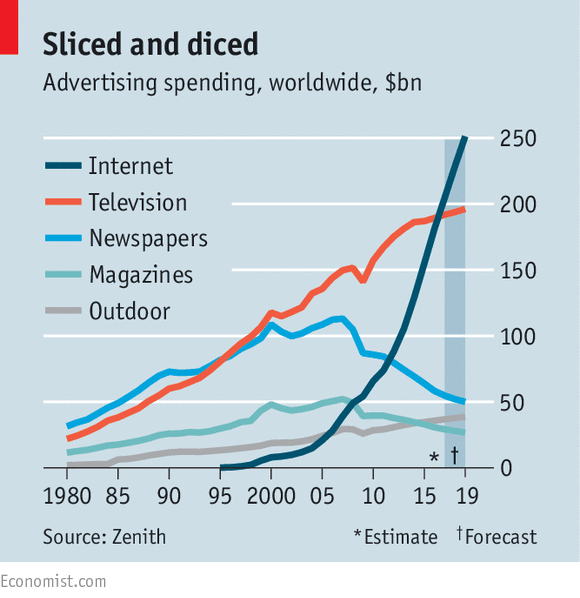
I don't see any evidence to support that. Total spending on advertising is increasing every year. Newspaper spending is down, Google & Facebook is way up. Overall it's up.
Yeah, it pretty much doesn't work well. The unit economics is something like "pay 50 cents a click and hope your funnel can monetize that effectively". More if you have more specific/desirable targeting, less if it's broader, but anything you save on the targeting end you lose in funnel effectiveness. If you've got solid data all the way through to conversions and lifetime value, that can either justify dialing ad spend up or down, and it's usually going to be down.
I agree that as an aggregate we're probably massively overpaying for ads for little average effect, but there may be a game-theoretic reason why it does not go away. What if out of 100 competitors the top one gains a lot from ads but the 99 others lose? All 100 have to pay to play to try to be that one. If they cooperated as a cartel they could all pay less for ads and consumers could pay less for products but that is unlikely to happen.
Advertising doesn't work that well if you look at the raw numbers. Assume you have a great campaign and awesome conversion funnel, so that you get 1% clicks and 1% conversion.
The math is 100 x 100, or one sale for every 10,000 eyes who sees your ad.
In a vacuum, those numbers are awful. If your entire marketing strategy is buying ads to convert to sales, then of course, advertising doesn't work, and really, you probably shouldn't be advertising in the first place.
but what percentage of ad spend on the internet is actually ROI justified? I'd guess it's pretty low, right? I got the impression it's dominated by big brand advertisers that can't calculate ad spend ROI anyway.
Affiliate marketing does not magically get rid of waste. It just transfers the risk involved to another downstream party, while buying a shield of deniability of the unethical and scam tactics commonly used by affiliates.
We are considering an affiliate model for a new side-product. Can you point out the worst issues we should watch out for ?
(Its a virtual-goods product. Not subscription, but usually multiple-return customers. Around 70% gross margin since we have some high upfront provisioning cost.)
> I think one side affect of the surge of IT into advertising, is that it has become easier to measure exactly how well advertising works. By and large, it doesn't, very well.
I just don't understand the anti-social media agenda. The same people who for 2 years have been saying that social media advertising is so effective that it got trump elected are now saying it is ineffective. They demand that political advertising on social media be monitored because it is so effective that it gets presidents elected. Now, it's social media ad spending is so ineffective that these companies won't be around.
> What's happening to billboards and newspapers right now is probably coming to several other industries soon.
What's happening to billboards and newspapers is that ad money is flooding into digital space ( where the young kids are ).
Obviously it’s a lie. The “right” is gaining in Europe like crazy, not because of Facebook, but because the existing governments have seriously underperformed.
But politicians faced with the choice of admitting mistakes that they don’t even know how to fix, or to wildly and randomly strike at whoever got blamed ...
"The same people who for 2 years have been saying that social media advertising is so effective that it got trump elected are now saying it is ineffective."
So does that mean you think that social media advertising is effective as people claim and Russian use of it got Trump elected?
Regardless of whether your "same people" is a straw man, the opposite of a set of inconsistent claims tends to also be inconsistent, so I'm not sure what you are trying to say here.


I am reminded of this, from Paul Graham, about his time at Yahoo: http://www.paulgraham.com/yahoo.html
"...The reason Yahoo didn't care about a technique that extracted the full value of traffic was that advertisers were already overpaying for it. If Yahoo merely extracted the actual value, they'd have made less."
I'm pretty sure that, the more we learn about how well advertising works, the less money people will be willing to pay for it. What's happening to billboards and newspapers right now is probably coming to several other industries soon.