One of my startups was purchased by QLogic, which made PCI cards in bulk. One of their corporate standards is that prototypes have red PCBs, to prevent them ever being mixed together with production parts. These days I have some friends who have a particular debit card that's the same color of red. Every time I see it, I twitch.
At work we often try to do a different color for each revision so you can tell at a glance what's in a given unit. It's definitely saved me a few times!
We use different solder mask colours to differentiate different product variants that share a board outline. It is way easier to tell a factory to install the red board when making a specific product variant than to have them read a part number off the board.
I used to buy some quadcopters and parts from China, and there is a particular board revision that was horrible. It was easily identifiable because it was red. I wonder if this was a prototype or early production run that just kept going. I was buying this particular model for about two years, and the reds would show up during this entire time.
Cheerson CX-10. Great quad for teaching, but very unreliable. Also, most parts can easily be scavenged from other ruined quads but the aftermarket propellers are horrible.
Sparkfun does the red for branding. Their early stuff was green. They also use black for their SparkX experimental boards. Adafruit is know for their blue boards and oshpark for plurple it’s all branding.
I would guess not, given that these days (At least in small quantities, which I assume scales) the choice of colour is aesthetic (To first order) rather than dictated economically.
> 1. Green can relieve visual fatigue and aid in inspections
> In the early days, due to technological restrictions, quality inspections relied on workers manually checking the boards with their bare eyes. Squinting at tiny circuits all days is tiring work, but neurologists and psychologists agree that the wavelength of green light has relaxing effects on the body and can reduce fatigue. Additionally, they have found that the sensors in human eyes, or cones, are most sensitive to green light. Therefore, the contrast is greater between the circuit traces, pads, silkscreen printing and empty spaces. Just by observing the boards from the outside, one can easily identify defects in the outer layers. Compare the below images of green boards to other colors such as blue, yellow or even black and white. With higher contrast, errors are easier to spot.
Perhaps an IDE theme with a green background would be similarly helpful for programmers. Any particular suggestions?
Human eyes are more sensitive to slight variations in green than other colours. This is why YUV video often encodes green sharper and why 16bit colour give 6 bits to green and 5 bits to red/blue. So on a circuit board with subtle green-on-green variations, it makes sense that they picked green.
But since people have many more rods than cones, black/white contrast is easier to discern and white uses all the subpixels in your display to maximize luminance. And speaking of subpixels, subpixel antialiasing effectively triples your resolution when displaying black/white contrast.
The brain also highlights contours of contrasting black/white. (There's an evolutionary quirk in our blue-sensing cones that allows you to see contrasting blue/yellow better than most combinations too but still not as well as black/white.)
So sharp white on black or black on white are typically better suited to human vision if you're trying to discern outlines like when reading text.
Black/white also avoids the persistence effects that cones have, where when you look away from a green image for example, you'll see an inverted magenta copy of the image for a second or two.
My recollection is that it was mostly for brightness. I think the amber phosphor had shorter persistence and was less prone to burn-in as well. But yeah, kinda harsh on the eyes in comparison.
Most ”black”boards these days are green, apparently for similar legibility and eye fatigue reasons. Color schemes with a similar background color are definitely available for text editors.
In various places I have worked we used Red color soldermask to indicate that the PCBAs were in early prototype stages(EVTs,DVTs) and once the final designs were released for manufacture(PVT) they were Green in color. This also was used to indicate that these boards were RoHS compliant. Again, this might have been very industry specific(Medical devices in my case) and YMMV. IN another FAANG place that I worked our ODMs who also worked with Chinese Fab houses started out with Green soldermask. Nowadays I find it fascianting that one can order preactically any solder mask color one chooses to, though i have a special affinity towards pink.
Interesting example of a place where a small but meaningful advantage in a manual application (reduced eye strain during visual inspection) leads to a larger, nearly insurmountable advantage in a world where the task has been largely automated thanks to preexisting R&D/economies of scale. I expect we will see more and more of this in the coming decades across multiple industries.
The authors of the paper seem to believe that the object would have been to slow down the typist (had the jamming hypothesis been correct). The opposite would have been true. Increase the difference of the angle of approach of successive hammers, and you decrease the chance of jamming and increase the speed. I'll admit that the Z-SE ("dot-dot-dot-space-dot" in early American Morse, with the length of the space/mark mkaing the difference) problem makes some superficial sense, but then there's a corresponding R-EI ("dot-space-dot-dot") and others that aren't reflected on the QUERTY keyboard. (The original Morse code needed far too much space-length discipline, which is why it was replaced fairly quickly, even in the NIH-heavy USA.)
Small but meaningful advantage in a manual application:
* Guiding the user to guide a complex machine through a precise sequence of steps in order to achieve a goal, such as reading mail or writing a letter
Automation:
* Natural language recognition, shell scripting
Economy of scale:
* Beautiful formatted text has lost its value due to being ubiquitous, and more and more document processing consists of copying and pasting in an e-mail program
At this point, they're usually green because they're usually green. It's the most common mask color, therefore the cheapest. Also, oddly enough, not only do different mask colors have different achievable resolutions (minimum line widths) - some colors don't stick to the PCB as well!
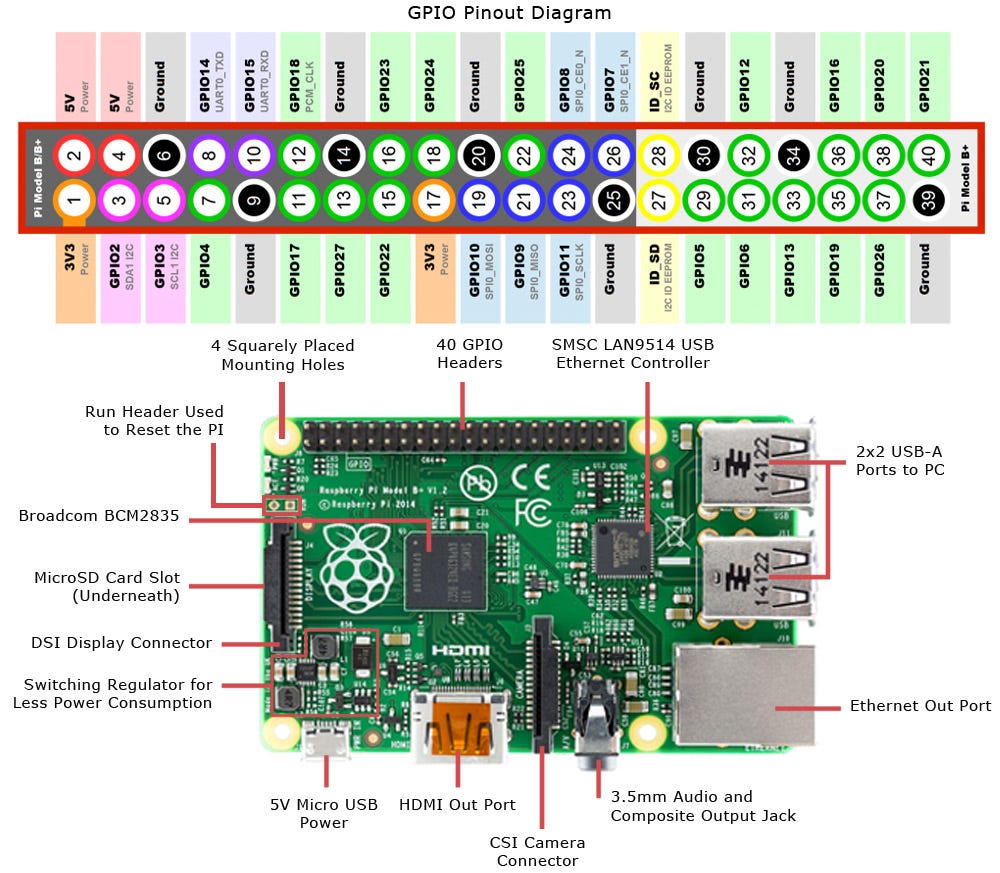
Pinouts usually use red and black to indicate power and ground [1]. It's possible to use several colours of solder mask on the same PCB. [2]
What I'd like to see is a developer board targeted at the education market that uses colours to show the traces.
I think that at least showing the power and ground could reduce the risk of shortouts. It would be a lot easier for teachers to say "plug the red wire into the red pin" instead of "the top right ... no, other top, turn it around".
Possibly chemically. Practically? EVERY other solder mask color is better.
I find that because green is the default, cheap, PCB soldermask, manufacturers thin it to hell and back in order to save money. As such, I regularly get coverage gaps over vias underneath QFN components which then short to the pad underneath the chip. (Manufacturing tip: if you can, only put vias underneath the chip that are tied to the same signal as the QFN thermal pad and your reliability will be much better.)
If I want good soldermask coverage, I always order an alternate color (with the requisite expense) and almost always get great results.
They're beautiful. Good luck oxidizing any of that in normal environments, those scopes will outlast the people that built them. Old computer hardware used to be just like that, I would buy the boards by the pound in the 70's for parts. Gorgeous stuff.
Annoyingly the IC sockets tend to oxidise if the board doesn’t! I’ve lost count of the number of them I’ve had to replace in my life.
If it wasn’t for mechanical switches, pots, contacts and some dubious thermal design I imagine the kit would last for 100 years easy. I have 40-50 year old stuff on my bench in daily use.
Yeah the Tek scopes were made before they came up with them though which is annoying. I usually replace them with the Harwin gold plated turned pin ones as I got a massive box off them from eBay for virtually nothing :)
They were tan because they were made of phenolic paper (wood fiber) laminate. Modern PCBs are moade of glass fiber epoxy laminate material and they're usually clear/white without any solder mask dyes.
I suspect it's a deliberate choice both as a fashion statement and to discourage repair.
It's interesting to see a similar phenomenon with desktop PC motherboards: "gamer" or otherwise "enthusiast" boards are often a non-green colour and come with superfluous design elements (like plastic covers over the actual components, which sort of remind me of the engine covers on newer cars...), while both the ultra-cheap prebuilt and ultra-expensive server boards remain green and free of fluff.
I doubt it has anything to do with repair. When you’ve got a 18 or so layer PCB, probably with microvias (invisible if they’re in pads), and very closely spaced QFN and BGA-packaged parts everywhere, soldermask colour is the least of your problems. So much of the design is on internal layers inside the board and so much interconnection to internal layers in pads (if using microvias) and under BGAs that being able to easily see the top and bottom layer traces easily would give you very little to go on. You’d really need design files to do anything more than just reflowing the odd part...
It probably is a lot to do with fashion though. It’s literally one of the only reasons that I always specify blue or black soldermask at work - just looks a lot cooler. Green boards just have that late-90’s electronics look.
I blame case windows for this. The last desktop I built, it was a chore finding a case that didn't look stupid, and I eventually gave up on a normal motherboard, as anything with a z170 chip set looked like it belonged in a transformers toy.
And while people definitely geek out over servers, it's nearly all about specs. After all, why make something that gets hidden away in a rack in a DC look pretty?
I suspect that is one reason Apple isn't using green mask, since the connotation for many people is 'cheap'
I think that’s because they want the bits you can’t see to look as good as the bits you can. I rather like poking around inside apple kit. Always have a smile on when I have to.
Some flex circuits are black because they use a conductive coating to create ground planes without increasing the stiffness as much as another set of copper/adhesive/coverlay layers.
The black stuff on flex circuits is actually dual purpose. Stiffener and also EMI shield.Flex circuits in Consumer Electronics is typically used in Two places. Camera module interface and Display interface both of which push serial data to upwards of 1GB/s LVDS(MIPI) CSI and DSI. And due to tlack of dedicated ground planes( cheaper) they add a adhesive that serves to contain emissions from the 8b/10b(Manchester) encoded data stream.
What this article doesn't answer is, when it talks about the green soldermask being physically superior, is that only because it's had more R&D put into it due to being popular, or would it actually be the best regardless? (Admittedly, I don't know how one would possibly answer that question without, like, actually trying to invent better soldermask of other colors. But it bugs me that the article doesn't even ask the question.)
Solder dams come down to a bunch of factors, but the bottom line is basically the best dye is the one that lets the resin cure stable and strong.
For instance, white dyes are hard (for a lot of things) because white dye particles are large[1] and you need a lot of them. That means they can interfere with curing.
Green dye can be relatively small amounts since green is so visible to the human eye, but afaik its more down to the fact that theyve been able to tune the dyes down better over time.
[1]: also why you can't dye anodized aluminum white. Most dyes are colored at the molecular level, and are much smaller than the wavelengths they reflect. White dyes need to reflect every wavelength, and normal molecules only reflect quite narrow ranges where they resonate.
In order to reflect white light you need particles at minimum the size of the wavelength. Then you need a range of particles for each wavelength. In practice this judt gives you black, since each particle will also be absorbing light at other wavelengths. You need one size of particle with fine, often fractal-like microstructure that has features at every size. That means white dye particles are hundreds of times larger than colored dyes.
I love that OSH Park (https://oshpark.com/) uses purple soldermask. It's a fairly unusual soldermask color, but they use only purple. It looks great with gold plating, and it gives a satisfying sense of branding to for open source hardware and prototyping.
Actually OSHpark boards I find are pretty crap. They have mouse bites left over, the mask is crap and the registration poor on some boards. Getting better boards from JLC but you lose HASL and purple.
Yeah, there are a lot more options for easy, small-batch prototyping PCBs these days. OSH Park was one of the first that was really easy and accessible to hobbyists, so even if it's not the best or the cheapest any more, the purple soldermask still has a place in my heart.
Nit, but I doubt silk screen mask is used much these days. When I was last involved with board production 20+ years ago all our vendors switched to photoimagable mask in order to get the registration accuracy and resolution necessary for fine lead SMT.
Somewhere in the early 3D video card years, I took one out of the box and the PCB was red! Blew my mind. I want to say it was a Diamond card but I'm not 100% sure.
Yes, that's the first non-green PCB I can remember, too.
And it took a while until I saw it become common -- I guess a big incentive was the appearance of side windows on PC cases. At first all DIY (Dremel), then commercially sold.
The article mentions that there are "even mixed color boards", does anyone have a photo of any? I did a cursory search and didn't see any, but am interested in how these looked.
I recall reading that the map of Italy on the back of an Arduino Uno is tendered using white solder mask, because traditional silk screens did not provide enough resolution.