The interesting thing about the Magnus effect is that the lift goes up with the second power of the radius of the rotor, so twice as large gets you four times as much lift. The largest Magnus effect vehicle I know of was a huge sphere with the crew cabin hanging below it from the axle. The whole sphere was the lifting body.
The old OMNI magazine had an article wherein they calculated that you could put Magnus effect rotors on a bus and it would fly at (speeds as low as) 35mph.
I've had plans for years now to build large flying buildings (if I can get my act together I might eventually do it) using geodesic cellular kites and the Magnus effect. (Look up Alexander Bell's kites, and Bucky Fuller's "Cloud Nine" aerial city concept.)
The interesting thing about the Magnus effect is that the lift goes up with the second power of the radius of the rotor
Due to E = mv^2, doesn't the energy required to spin the rotor also go up with the square of the radius? Thus, the amount of energy is directly proportional to the amount of lift, so you don't get any magical quadratic gains for free like your post implies.
Think of the cross-section of one of these rotors, it's a circle, yeah? We're not interested in the interior of the circle, just the perimeter, which increases linearly with the radius. (We can make the interior out of wire spokes like a bicycle wheel.)
Ah yes, but you have the option to use more power. The way I describe it is: The Magnus effect rotor is to the wing as the wheel is to the sled runner.
But the whole game of airfoil and wing design is to optimize the lift to drag ratio, i.e. how much lift is produced per propulsive power needed. Sure, given enough power, you can just remove wings altogether and simply fly an engine.
It probably (?) wouldn’t increase the drag of the aircraft significantly, but you’re still spinning a cylinder in a viscous fluid and that takes energy. So over all, you increase the power you need to put into the system to create a certain amount of lift. Whether the energy expense comes as an additional propulsion requirement to overcome drag or as an additional motor to spin the cylinder does not really matter if you’re interested in the lowest power expense for a desired lift.
You and the other folks responding to this so positively have got me doing some soul-searching. One of my personal limiting factors on this is that there hasn't been a lot of interest so far. It's like, why perform if there's no audience?
("But, if we don't perform, in what sense do we have an act?" ~B.B. Rodríguez)
I'm joking, but I'm also serious: if you really want to see this happen the most useful thing you could do would be to pay attention to it. If I know folks are interested that's hella motivating, y'know?
I'm not sure it would be wise to take people's money. I've burned a lot of investor money in my career as a computer programmer and I've gotten to the point where I'm reluctant to do it again. Not to mention that there's no good reason to suspect I've got what it takes as a founder. (And I've got no team and few connections, so...)
In any event, FWIW, I have a plan for bootstrapping: starting with toys and kits, then moving into certain niche applications (such as drone swarms to collect and deliver water to contain and extinguish wildfires) and finally winding up with large structures for mass shipping, human migration, launch platforms for space rockets, etc.
Like I said to dragosmocrii, if you really want to encourage me just join my mailing list. :)
Potential flow theory tells us that the lift L is L = rho U Gamma, where rho is the air density, U the flight velocity, and Gamma the circulation, i.e. the tangential velocity of the rotating surface times the circumference.
L is then only proportional to the radius, not to the square of the radius.
Dunno what to tell ya, I'm not an expert, Wikipedia says: Gamma = 2πr²ω where "ω is the angular velocity of spin of the cylinder (in radians / second) and r is the radius of the cylinder (in metres)."
https://en.wikipedia.org/wiki/Magnus_effect
Ok, omega * R is what I referred to as tangential velocity, you’re right.
I don’t know if that’s a useful way to look at it, though. It’s like saying “if I just made my car tires a mile in diameter, geez, I could be so much faster!”
Regarding flying spheres, there's also electro(static) lift caused by Earth's electric field pointing upwards. The drag is microscopic, but some tiny insects have figured how to use it for flying. I wonder if a light sphere could use an electromagnetic motor to create a strong electric potential and use that to move vertically? In an ideal world, this electrostatic drag would also grow quadratically with the sphere size so it would be possible to lift a hundred kg with a reasonable sized sphere.
MS Viking Grace has rotor sail. Fuel savings are 300 tons per year from the sail. It also uses LNG fuel. In best conditions the sail can provide 20% fuel savings. In reality much less than that, but it's a small sail compared to the size of the ship. Viking Grace is a cruiseferry, so even in full capacity it's almost empty compared to a cargo ship.
Maersk Pelican (tanker): 8.2% fuel saving during the first year of operation.
Using sails to increase fuel economy seems like a no brainer, but now I’m wondering if cargo ships were ever using sails to increase their maximum safe cruising speed. Does anyone know?
Sail died off pretty quickly once steam came in. [EDIT: Apparently in some applications much faster than others.] In the case of modern examples, I'm pretty sure it's been exclusively for fuel economy. And, until recently, the overhead associated with using sails was generally more trouble than they were worth.
Yea, the original limitation was the manpower cost of manning the sails which is why they where eventually dropped. With modern systems they are almost completely automated, which makes them far more viable.
It was not the manpower cost that was the limit. Steam ships had huge crews managing the engines. Titanic had 25 engineers, 170 firemen, 73 coal trimmers and 33 greasers.
It was the size. Sail ships had practical upper limit for their size and weight. Size of the mast and sails could not just grow.
Square–cube law: (drag) surface area is proportional to the square while the volume is proportional to the cube. Bigger the ship, more efficient it becomes.
It’s important to realize that 300 man engine crew was needed in large part do to the Titanic’s fast 21 knots cruse. A slower vessel of the same size and weight needs dramatically less power. By comparison the last commercial bulk cargo sailing ship Palmer which sank in 1957 needed an 85+ man crew, only had an 8-9 knots cruse, and was vastly smaller. For the titanic to add an extra 200+ crew to possibly save less than 10% on fuel costs was simply not tenable.
Where combined steam and sail ships really benefited wasn’t fuel, it was consistent power. Early steam engines where unreliable as was sail, but they rarely failed at the same time. However with more reliable steam it was just a question of economics.
There's a Liberty Ship that sails out of Baltimore at times [1] and if you go down into the engine room you can meet (or could 3 years ago) a greaser who sailed with these ships during WW II. They were the last mass-produced steam ships in the world [2].
the economics of fast sail clippers such as the cutty sark were limited to high value, low weight products such as specialty teas. the actual cargo volume in such a sail clipper was fairly low. an analogy for today would be air cargo freight in 747s of fresh flowers or something.
Ocean liners (and certain types of cargo) makes sense. An increase in speed can work economically even though it's not efficient. From what I was reading, sail went out in most military ships fairly quickly but that's a different set of constraints and priorities.
> A rotor ship is a type of ship designed to use the Magnus effect for propulsion. The ship is propelled, at least in part, by large powered vertical rotors, sometimes known as rotor sails. German engineer Anton Flettner was the first to build a ship that attempted to tap this force for propulsion, and ships using his type of rotor are sometimes known as Flettner ships.
Container ships reduce the superstructure to enable loading but these rotor sails could possibly be used on oil tankers and bulk carriers. We don’t hear about autonomous water vessels very often, perhaps a Flettner water drone is possible.
As noted in the article, many of these ships may need the ability to stow away the rotor to be able to pass under bridges anyways. It could still be viable for container ships.
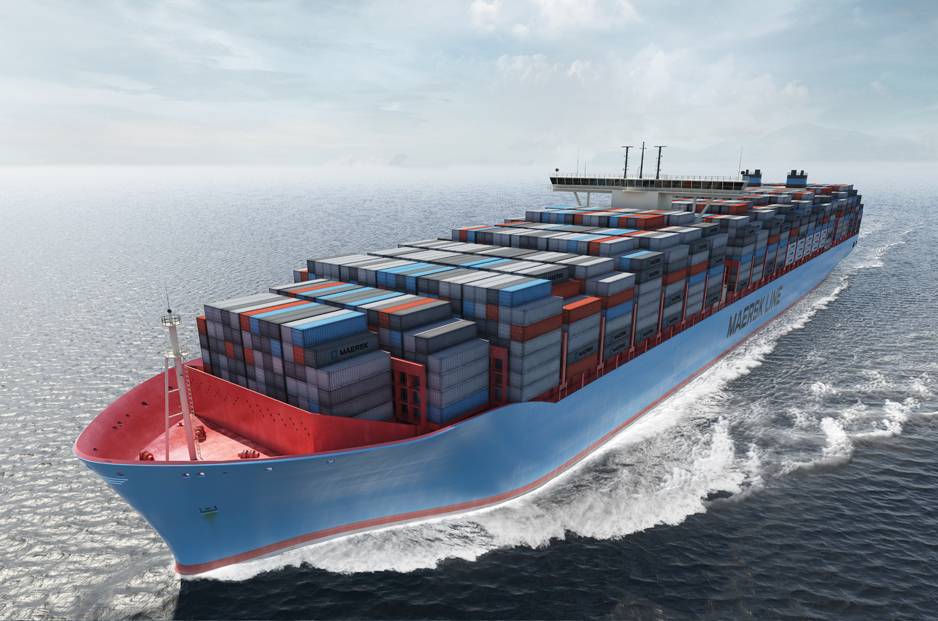
Looking at a picture of a large container ship there's more of a challenge siting rotors. Up high they would be in the way of cranes loading containers and might require really strong (and large) towers to hold the rotors. Built only as high as the containers, it doesn't seem like they would see any wind.
How would you envision them working on a container ship?
I'll admit that I straight up don't know how the structural loading would be like - but I seems to be me that you might be able to get some sort of telescoping solution that works ok. Since you'd probably need to clear the containers anyways to get the most of the power out of the system, the lower portion of the sail doesn't need to be a rotor - just a mast for the rotor section to telescope over.
I can't recall the researchers name, only that they had some association with NCSU, but they worked heavily with wind-propelled aquatic drones. I remember a talk they gave about waiting for wind conditions and the quirks of the control system.
From the article : "Ships can easily be retrofitted, literally overnight, with rotors activated by an on/off switch."
I think kite systems require more work, e.g. for launching & landing. When it gets taken down, you probably need to dry it, fold it, stow it, etc. So even if they are more efficient, lighter & cheaper, doesn't mean they're necessarily the preferred solution.
Ships can easily be retrofitted, literally overnight, with rotors activated by an on/off switch.
Kite systems seem far less practical but this can't possibly be true unless they're talking about a Sunfish. And even then, I'm skeptical. Or maybe they're using literally, as is the fashion, to mean figuratively.
That picture is not of an auxiliary retrofited sail, but of E-Ship 1 which is all sails. The retrofitted ones are much smaller relative to ship size and are used together with main engines.
Perhaps they could, assuming somebody is willing to make the necessary investment to develop what you describe.
However, it will probably be a complex system, and like most complex systems, it will be fairly fragile. Compare that to these Flettner rotors, which are essentially "a tube and a motor".
> In comparison to kite sails, Flettner rotors often offer considerable efficiency gains when compared to the size of a sail or kite vs. size of the rotor and prevailing wind conditions.
But I'm not sure if this size comparison makes all that much sense (maybe the performance per dollar invested would be more interesting?)
I'm genuinely curious about a comparison from an operator's perspective, and I also hope both approaches are being developed further.
Kite surfers are the assholes of the sea according to some sailors. I've seen them zip in and out of navigation channels and between boats. Also had a few get dangerously close and cross our bow as we were sailing on a reach.
Also, I do enjoy the sport. It's similar to endurance swimming and nearly every muscle in the body is worked. I found kitesurfers in some really remote banks and wondered how the hell did you get all the way out here.
Why not both? Flettner rotor works best when the wind is perpendicular and kite works best when the wind blows in the same direction to the ship's course.
If I understand the concept correctly the rotor does not only work as "sail" but also as "air propeller", as you need to input energy through its rotation (that gets multiplied by the "sail" effect of the Magnus effect). So that's an apples to oranges comparison, that does not bode well for the kite (as it is "passive", not effecting any compounding of energy).
Surprisingly, no. Last time this was posted there were some efficiency figures, wingsails being the best, but Flettner rotors still beating old-fashion sails and kites. And rotors are very likely cheaper than a sail/kite long term (they need complete replacement quite often because of rips and tears).
What I've read previously is that the kite systems took more training and skill to utilize, which was holding back adoption, whereas this sounds like it would be a much easier technology to use. Although, I do wonder if one could use both.
[edit] P.S. from my understanding of the mechanism, I'm not so sure these Flettner rotors are useful in a headwind. They work by creating a pressure difference, but in a headwind, you could only create a pressure difference between the port and starbord sides, not the front and back. Unless there's some mechanism I'm missing?
If, by headwind, you mean sailing directly upwind, then no, they cannot do that, but they can beat to windward like a sailboat (the direction of the rotation must be reversed when tacking.) According to Wikipedia, the rotor ship Buckau could sail within 20-30 degrees of the wind, though I suspect that is a misreading of the supposed source of that data, and that 50-60 degrees is a more plausible figure. Similarly, I suspect the claim that they can sail closer to the wind than conventional sailing vessels is in comparison to square-rigged ships.
To second the others, "reaches" are the fastest. I forget why, but I suspect it's like gearing, less force, more distance, for the same amount of work.
Very little discussion here or in the article on why use these in favor of traditional sails. Looking at America’s Cup, the trend one would expect would be foils supplemented by motor and more traditional sails. I’m sure these are easier to deploy, but consider that an America’s cup boat can do 40 knots in a 12 knot breeze. Sure that’s without cargo and on a highly optimized design with hard working crew, but it does prove the remarkable efficiency of a traditional wing.
You can just install these rotating wings on the deck and get 5-7% increase in fuel efficiency immediately and lasts 20-30 years with minimal maintenance. The investment pays itself back in 3-8 years.
Wing is obviously more efficient. The problem with the wing is the cost and size. You need to design the ship for the wing. https://en.wikipedia.org/wiki/Oceanbird
The newest AC monohulls are amazing devices, but they're not relevant to cargo or merchant vessels. Foils are a form of dynamic lift, where the weight of the vessel is critical. Those AC75s are full carbon, made a great expense. They weigh around 8 tons crewed up. The average container ship today weighs 100,000 tons. That's a whole lotta dynamic lift needed.
Additionally the AC75s are only usable in relatively flat seas, and even then face extreme hazards if they fall off the foils. The foiling cats some years ago killed someone due to this.
Fully flying hulls on cargo ships are a non starter.
However, wing sails may be practical as an assist, and there've been a few startups attempting that in recent years. The best design for cargo ships is a bit different than the AC boats, and uses a fully rotating and self trimming wingsail. See saildrone for an example of that technology at small scale.
> but consider that an America’s cup boat can do 40 knots in a 12 knot breeze
an america's cup boat is to sailboats what an F1 racing car is to a toyota camry.
at the very high end of bespoke carbon fiber racing sailboats with crews of 8 or more, we're talking about toys for billionaire status symbols... Look at the ownership and sponsorship of the boats in this for instance: https://en.wikipedia.org/wiki/The_Ocean_Race
Wonder if you can make inflatable tower for lesser weight and reefing. Maybe there’s some stable design where you start foiling using motors then when you are stable - use excess power to turn rotors. AC75 boats are very unstable without foils and these things are heavy as.
Oh, there's more than one? I only know the one that ends up with https://chocolatemakers.eu/eu/de/19-schokofahrt getting distributed from the Netherlands across neighboring countries by cargo bike. Surely won't scale for anything other than awareness luxury gifts, but that cannot be seen as a reason to look the other way when you happen to buy luxury gifts.
Oh, Flettner rotors again. Those keep coming around. Jacques Costeau used to have a rotor ship, the Alcyone.[1] It wasn't really worth the trouble. "In fact, we were motoring most of the time" - Alcyone's captain.
Would like to see more about what's going on below the waterline. The challenge with any form of wind power is that the propulsion doesn't typically point forward - it's at an angle with a forward component. So on a sailboat you need a long keel (or centerboard/daggerboard) to translate the lateral propulsion into forward movement. That constricts the vessel from operating in shallow waters and causes the vessel to lean due to the opposing force under the waterline.
Regarding the two towers : if you look at the E-ship 1 [0] you'll see 4 towers - 2 in the front, 2 in the rear. There are no towers in the middle, probably because that area is intended for cargo.
I presume there is also a minimum distance they need to be separated - if you look at some of the illustrations of the Magnus effect [1], you'll see a turbulent region downwind of the tower. Another tower in this turbulent region won't work as intended.
This is pure speculation on my part, but perhaps most ships simply aren't wide enough to have two towers side by side (the E-ship 1 being an exception). That, and wanting to use most of the ship for cargo, explains why most ships only have 2 towers.
Theoretically, there is no aerodynamic difference between a rotating, perfectly smooth cylinder and a non-rotating one. I'm not a physicist, but judging by the fact that basketballs tend to perform best in popular Magnus effect demonstrations, I'm assuming some surface texture is necessary.
On photos it always looks smooth. I guess you also need to make sure it doesn’t cause too much drag when not in use (for example, if you travel against the wind).
I wondered that as well - I suppose the added weight/complexity of using vanes that could be folded in (sort of like a big turbocharger) must not be worth any gains. Hard to beat the simplicity of a big tube.
I'm just thinking out loud. Some things don't need fast shipping. Instead it needs a steady and even supply. And if a ship doesn't use any fuel, it could even serves as a kind of movable storage house. Thus I'm really looking forward for the developement of autonomous sailing ships. I really believe there's a market for them, or at least a niche within shipping.
Although reducing speed and fuel usage reduces fuel costs, it increases fixed costs (you need more ships for the same throughput) as well as operating costs like crew. It might turn out to still be more expensive in the end. Then there's the problem of less certainty about price changes if you have to wait longer for the product to be delivered which leads to inefficiency (over/under-supply if mispredicted). There's also the opportunity cost of money being tied up for longer in the delay between production and consumption.
Kidnapping and ransom seems to be the most profitable part of piracy. Insurance costs would likely go down for unmanned vessels. You could spend money on arms and mercenaries and RPG launchers and machine guns and escorts and drone squadrons through danger zones, but it is cheaper to just pay insurance. If insurance stops working, the next cheapest would be to pay pirates protection money to keep other pirates in check.
Along contested shores? Yes. That's where you'd employ the coast guard or naval forces to protect the vessels.
Perhaps you could even bring aboard an armed crew as needed, or employ various defences, beginning by making it harder to breach the containers, up to just about any fully automated defence system you can imagine.
There were some planes that used this concept, but they were never commercially successful (partly because if they lose power they cannot glide to a landing like a normal plane can). I think it was used in some bomb designs as well.
It's one of the hard bits of decarbonization. The current trend is towards lighter varieties of fossil fuel (especially liquefied natural gas). In the long run, it could be fully decarbonized with hydrogen.
You'd have to overcome the drag of that array. At a rough estimate at 1 KW / square meter for half the day it wouldn't be worth it unless you added a way for it to be pulled in at night (which is going to be pretty hard to do with solar panels which are quite fragile).
On top of that, the ocean is about as hostile an environment as you could wish for and it wouldn't work anywhere near busy shipping lanes.
They don't. The lift is orthogonal to the wind direction, so it will be most efficient when the wind is directly from the side, with the forward force falling of with the cosine of the wind angle. There's really no way to change that with these types of sails.
This is actually quite an important limitation for cargo ships, as wind directions on the large oceans are somewhat constant and mostly east-west. Hence these sails would be better for north-south routes.
Water offers a lot more friction than air and requires a lot more energy to push a ship through than can be generated even if we cover the entire ship surface with panels. Of course, it can offset some of the energy requirements. The ship can be made wider to accommodate more panels, but that in turn increases the contact between water and hull, increasing friction. If we extend the panels over the hull, wing-like, the ship will be unstable under the windy conditions often found at sea.
Indeed. It's one of those recurring engineering memes that makes the rounds every decade or so. Id be surprised if it hasn't been on the cover, or in the pages of, Popular [Science|Mechanics] at least once a decade for the past 50 years.
What I personally don't understand is why these aren't themselves driven by a vertical air wind turbine. The rotational speeds aren't very high, and it seems like a no-brainer. A VAWT with variable vanes could easily be shut down in a storm.
It doesn’t seem quite like that. There appear to be a dozen or so of these ships already running, and more being converted. Perhaps this remains a small niche, but it certainly is an area of active investment and growth today.




The old OMNI magazine had an article wherein they calculated that you could put Magnus effect rotors on a bus and it would fly at (speeds as low as) 35mph.
I've had plans for years now to build large flying buildings (if I can get my act together I might eventually do it) using geodesic cellular kites and the Magnus effect. (Look up Alexander Bell's kites, and Bucky Fuller's "Cloud Nine" aerial city concept.)
- - - -
http://www.rexresearch.com/flettner/flettner.htm
http://www.rexresearch.com/skybow/mueller.htm
http://www.rexresearch.com/aero/1aero.htm#thompson
http://www.rexresearch.com/aero/1aero.htm#flettner
And I found some images but not the name of the upside-down-hair-band-sphere design on this blog post: https://steemit.com/airship/@everittdmickey/magnus-effect-ai...