Japanese carmakers are going to become irrelevant [1] unless there's a major change. But that's very unlikely due to:
  1. Supply chains and key raw materials mostly controlled by China
  2. Japan's demographic collapse
  3. Japanese Gen Z fed up with an unwinnable rat race where they live to just pay rent and groceries
I don't understand what point you're trying to make with your source. A relatively new company in the Japanese market (BYD) has increased sales in its specialized niche of EVs, beating out a minor competitor that sells only one model of EV as an option to it's brand loyal customers (Toyota, BZ4X). Meanwhile, the EV market as a whole has declined significantly in Japan over the last year.
Irrelevant to whom? Toyota, Honda and Subaru all have lifelong customers and for good reason. The cars often last for 20+ years with minimal upkeep.
The current crop of Chinese electric car makers are all trying to fake it until one of them makes it and the money spigot keeping them afloat will eventually get turned off at some point.[0] Good luck keeping that flashy EV running when the company goes bust.
All cars last 20+yr if you give a crap unless they have some fundamental engineering or execution Achilles heel (ecoboost water pump, Toyota frame rust, Hyundai engine problems, etc) that will manifest as a comically not-economical repair when the vehicle is old enough in age to be of fairly low value.
Premium cars that aren't so premium as to be disposable (i.e. not a luxury car you're gonna trade in every 3-5yr like clockwork) always last really well because people who can afford nice things can generally afford to maintain them.
This is pretty clearly borne out when you compare same cars across brand e.g. Ford Lincoln Mercury panther platform cars) or look at the exceptions like all those objectively terrible northstar caddilacs and v12 Jags and whatnot that are in impeccable shape because they got used and maintained nicely for a decade before being "retired" to the garage of the owner's vacation property on Cape Cod or perhaps the Hamptons or compare airport people moving vans that were retired to church group service to work vans that got sold down the river to even harder service.
It's really easy to "well we really should sell a water pump while we're in here for your 100k timing service" on a Subaru owned by someone who can afford a Subaru vs selling a preventative transmission fluid change to the guy who could barely scrape together the down payment on a Sentra.
I'm being a little sloppy and leaving some loose ends and room for nitpicking jerks to wedge in but I think the point here is pretty clear.
Easily the biggest killer for most people in the continental US is winter road salt. You go to California and a decent fraction of people people are still driving the same 80s and 90s corollas in whatever condition at this point. That car was totalled decades ago in the northeast, and if it still exist you are liable to fall through the floorpan.
I have driven nothing but pre-2008 Nissans for about 20 years.
Not a single major failure across 6 vehicles, except one Nissan Silvia (1992) that I used to race. Not really it's fault, I blew the motor pushing it hard for 3 years. I also crashed my first Silvia into a tree at 16, but it was running fine before that. That's how it got to the tree!
Even the 2007 Pathfinder and current 2003 Stagea are rock solid, and I consider them post-peak for Nissan.
They have lifelong customers, but those also don't live forever and can change their opinion, and if the carmakers don't adapt, they won't survive. For the last 19 years we have been buying Toyota, but I'm slowly starting to look for a new car and it has to be an EV and Toyota is currently very underwhelming in that regard in our market.
Prime example: we leased 3 Nissans in a row (dipping our toes in with an Altima and then 2 Rogues in a row), so 9 years worth, but prior to the last turn-in, they released a new Rogue that was smaller on the inside (but I believe may have been slightly larger on the outside), sapped the power out of the base engine (our Rogues had some pep in their step), and as the final nail in the coffin, raised prices by 15% or so and lowered the lease residuals- the net effect was a worse automobile with a ~30% higher monthly payment.
Going from under $350/mo to over $500/mo on a 36-month low mileage lease made what had been an easy decision one way (just get another Rogue) into an easy decision the other way (get a different vehicle from a different manufacturer).
When you venture into the pricing tiers of higher-quality automobiles, you need to be equipped to play in that market. Nissan wasn't, at least in our situation, and it cost them a loyal customer.
For example, the formerly beefcake Landcruiser went from a beastly guzzling v8 in 2021 to a weaker v6 in 2022-2023, and now, in 2024, a weak 2.4L supercharged 4-cyl sipper.
R.I.P. Landcruiser of old, you were an ultimate vehicle in your category.
If you drive a new Tundra or 4runner with a lead foot in the city, you're probably going to get 10-ish mpg. Of course, that's just talking about stock vehicles. Plenty of modifications you can do a car to make it less fuel-efficient ;-)
A car getting 10 MPG consumes, in just 60 miles of driving, the energy equivalent of a household's monthly electricity usage, and can travel less than 200 meters on the energy generated by four hours of running on a treadmill.
Please explain to me how thinking that this is absolutely atrocious speaks to my limited worldview?
Sorry, I didn't state that very well. Permit me to retry.
For a lot of people (I'm not actually one of them; I don't even have a car, but I know many of them), the energy efficiency of their vehicle isn't one of the top concerns — or even a concern at all.
Gasoline is available everywhere; they make enough money that the cost of gas doesn't matter to them. They care more about things like: How comfortable is the car to ride around in? How fast can it go from 0 to 100kph? What is the top speed? Does it look cool? Is it bulletproof? Can it connect to my phone without me fiddling with it? Does it have a premium sound system? And so on.
Their response to your comment would be something like, "Whatever, hippie."
It's literally something that a lot of people don't think about even once. This forum doesn't skew that way, I reckon, but I'm pretty sure sure that the vast majority of people who care about fuel efficiency of vehicles care because their financial situation means they have to think about the cost of gasoline (and that is a lot of people, perhaps most). Then there are some people who care about it because that's just their nature, or because they've thought through the consequences and external effects of these inefficient vehicles (a small sliver of people, although energetic about expressing their opinions).
Do you consider the electrical power usage of your computer's GPU? Given your comment, I suspect you might. There is likewise a sliver of GPU users and enthusiasts who compare the efficiency of GPUs, and think about that when building, say, a gaming PC. But most gaming PC builders do not think about that much, and certainly not enough to sway their purchase (let alone feeling "ashamed"). They just care about how many frames per second they can get in their game, and if the drivers are going to be reliable and games will run well.
That's just how it is. Most people don't care about power efficiency until they have to care, because of the money.
Having said all that, now that I have been forced to think about it, yes, a brand-new vehicle that gets only 10MPG is, in fact, atrocious. Absurd, even.
If I did have one, "ashamed" might be overstating it, but I would at least be a little embarrassed — if I ever thought about it. But most people don't, and I think that is the answer to your question.
New car purchasing behaviour follows the law of double jeopardy. ie. Toyota has high repeat purchase rates because it has high market share, not because of loyal customers.
At least until the last 10 years people would try and sell Toyota on safety and reliability. People who wanted to extract every cent out of the cars life would get a toyota because it would legit go the distance without failure. Dealer told me that it doesnt hold true anymore due to electronics. But old corollas are still legendarily reliable first cars for teenagers. And I recall the used market for old hiluxes is beyond belief.
I'm only in my thirties, but I've been hearing this exact (!) sentence, about every single brand, throughout my entire life. Surprisingly, most of the brands are still fine and selling cars.
I keep hearing that too and it feels like a huge attribution error: the cars die because of the electronics because they are the new component with the shortest lifespan, so people blame them. Yet people fail to notice that the longevity of cars is on average, trending up while the amount of electronics in them has exploded. And it makes sense if you think about it for more than a second: which would you rather die first, the cheap electronic board/sensor or the expensive mechanical part?
My theory is that a lot of auto mechanics are very mechanically minded, so if the problems start being electrical they don't have the equipment or the skill set to solve the issue beyond simple power.
I saw a video the other day where a Ram truck was having issues on the CAN bus after driving 33 miles and would settle down after 10-15 minutes. The tech was pretty much stumped and pretty much only figured it out by brute force. A capacitor on one of the CAN terminators failed making its capacitance higher than spec and screwed up the filtration harmonics after charging for those 33 miles.
There's also two sides to "reliable" where either it's simple to fix or never breaks down. Always keep that in mind whenever someone is talking about reliability because it's never obvious which definition someone has in mind.
Eh tbh I think "electronics" is code for "DPF" tbh. Hiluxes had to be recalled to be fitted with a DPF manual burn toggle from memory, or they would just hit a wall and die.
Second hard markets for second hand cars a little bit different, reliable cars end up having higher loyalty through selection bias since they simply exist longer though.
Toyota doesn't really make money on a Hilux after the first sale though.
In my experience it has more to do with quality and affordability. If you like your Toyota Camry, you're probably going to get another Camry. Subarus are slightly different in that they have cornered a niche (snowy mountain driving) that many owners swear by.
Subaru has the snowy country people and gays down. Nissan used to have the same type of affinity with black customers - when treating alienated customers with respect is a novelty, people demonstrate loyalty.
Amazing you feel that EVs are somehow more maintenance than ICEs. There exist EVs that have never had any manufacturer/dealer input since the day they rolled off the lot.
Tesla/Nio are a bad examples - many EVs were built to be sold and essentially ignored by the manufacturer.
After that EV company goes out of business, how are you going to replace that bespoke {$random_part} that broke? Any Fisker Ocean owners want to chime in?[0]
Do the big companies really have a commitment to parts delivery anymore, or are they following the same trend? Took my friend 9 months to get a part for his C8 Corvette when it got rear ended at 5mph. Tons of other GM owners have been waiting months to nearly a year for many common parts for repairs. Selling parts doesn't make these companies money, so why should they care? As long as they're making enough to sell the new cars first.
* my Ford Focus EV had a very short lead time for parts because it was based on a platform (Focus) shared across many vehicles. Also repair cost was very low for a multi-car accident ($2k).
* Similarly, when common tech is spread across many vehicles (Kia/Hyundai eGMP or GM Ultium) those components are often easier to acquire.
Buying low-volume vehicles or from smaller manufacturers is a recipe for long wait times and expensive repairs. How many Corvettes does GM sell?
Funny thing with Fords is you can pretty much swap parts between models even if they are not officially in the same platform. Lots of overlap. Got a sync unit from a transit for a fiesta, works fine after updating the settings to match the vehicle.
Corvettes are niche cars, with only tens of thousands sold a year. Plus, I don't know when your friend got in that fender bender, but post-Covid supply chain issues meant that anybody in any newer car (with lots of electronics) who got in an accident in the past few years waited a while for parts.
Last week, I finally got my second key fob which was absent because of a chip shortage. So even until last year, we were still seeing the effects of the supply chain disruption.
There's one graph that basically predicts which countries are going to fail and which are going to prevail. It's the graph that shows how many people in the "doing things" age bracket a country has.
A key aggravating factor is most countries in the first group have stagnating productivity and the country in the second group has raising productivity on top. This creates a compound advantage for the country in the second group.
It seems likely to me that there is almost no degree of anti-national behavior the government of that country would need to exhibit or no amount of country-eroding policies that could forfeit this fundamental advantage. They'd need to get their country literally nuked or something similarly catastrophic.
Europe has largely converged on American growth, the East in particular continues to grow fast. But more important is that this is obviously an intentionally selective group of countries. Add Taiwan or South Korea to this story and it becomes a lot more complicated, because the latter is about to/has overtaken Japan on a per capita basis while having some of the worst demographics on the planet.
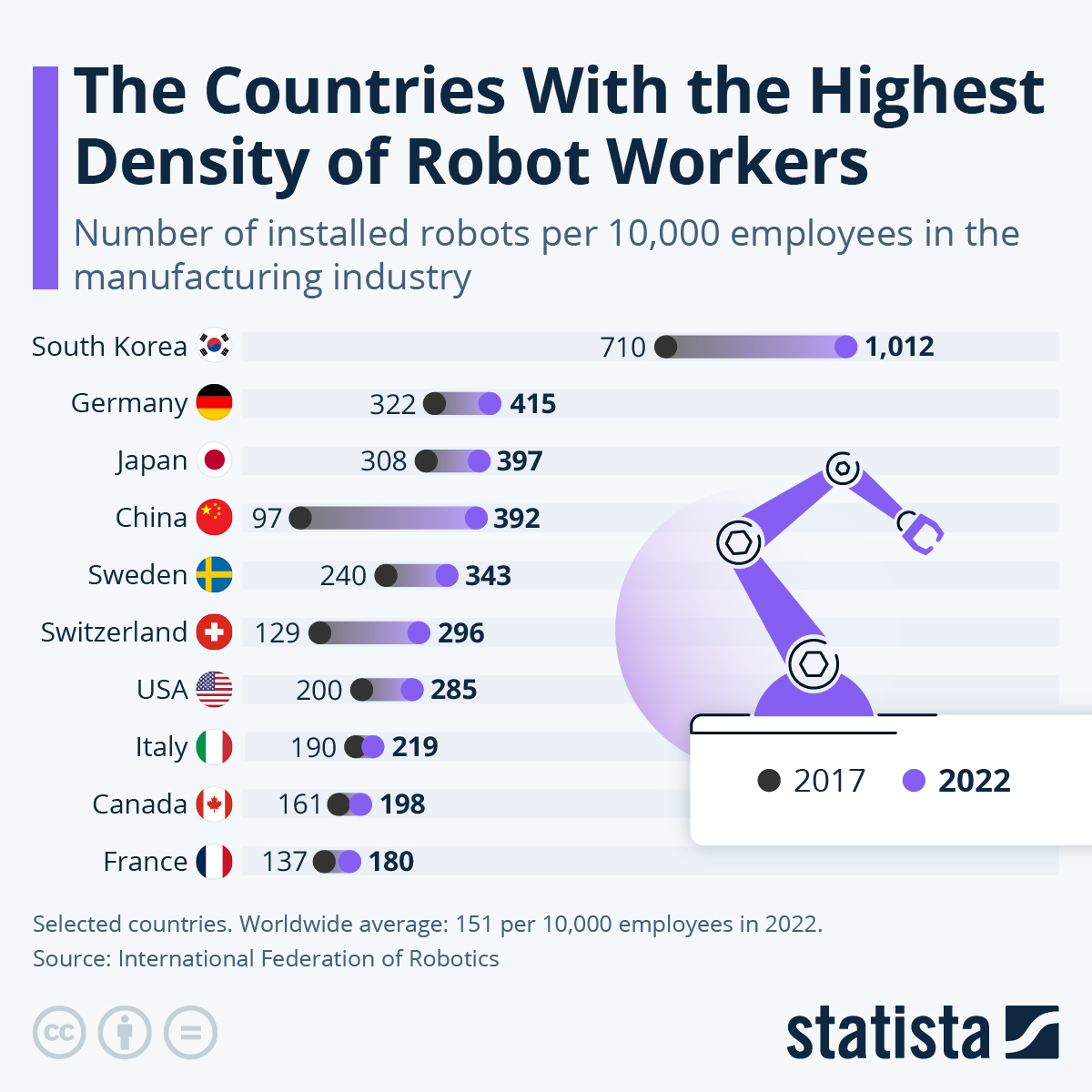
There's research by Keyu Jin that actually shows the opposite, globally growth after the year 2000 has been faster in aging countries for the simple reason that it increases returns on labor saving technology, i.e. automation (telling image:https://cdn.statcdn.com/Infographic/images/normal/13645.jpeg) and that is, even if you are conservative on technological developments in the next few decades, likely to accelerate quickly.
It is an important variable. But a more realistic picture needs to factor in:
  1. median IQ
  2. skills
  3. future unfunded liabilities (welfare, pensions, public health, etc)
China has demographics collapse like the West but they have high median IQ, high skills, and almost no unfunded liabilities. Meanwhile, Western IQ and skills are dropping like a stone and they have trillions in unfunded liabilities. And any attempt to fix it is either a drop in a bucket or going to trigger massive unrest. Just see what happened in France a year ago.
I hope China learns this lesson an makes some changes. At least they have a bit more runway to do so.
I think this really depends on how you define unfunded liabilities. China, for example, has mostly not established liabilities because the social systems for retiring are a joke. People instead save personally and shovel those savings into real estate, but the real estate market is collapsing/collapsed because it turns out all that retirement saving driving up the median-house to median-income ratio to 40+x was not sustainable.
To put in perspective how bad that is, cities the West considers expensive:
Paris is 17x
London is 12x
NYC is 9.7x
San Francisco is 9x
---
Shanghai is down from peak but still at 33x, and that's a correction. Either people still can't afford to buy homes, or a large class of homeowners will become destitute elderly people and all that entails for social stability, or the government will have to make up the difference somehow.
I’d also add that China actually does have future pension liabilities. China’s past one child policy is causing the pyramid to quickly go from 4-2-1 to 1-2-4 in terms of ratio of working to dependents; and young people are already not participating in pensions because they think its highly likely the systems will go bust and they won’t see a cent of their contributions.
Canada doesn't feel like it's winning despite what the graph says*. Bringing in tons of working-aged immigrants has caused housing (and other living) costs to explode, which in turn has lead to less people having children, which leads to more immigration to fill the gap and the whole thing has been spiraling. Not fun at all.
The problem with just "living by the graph" is that it ignores whether the country has the capacity to provide basics like food, clothing, shelter, and employment to the population. You need to have both to have the working-age population be able to engage productively in the economy.
The problem Canada created is that it tried to reset it's population graph without ensuring that there was an adequate supply of said basics, and in many instances (housing, food prices) had policies that actively undermined what needed to a happen to support a rapidly expanding population. JT and the other liberal leadership read the Century Initiative and all they took away as "we need 100m people!" (https://en.wikipedia.org/wiki/Century_Initiative)
It's not that a country couldn't theoretically be successful resetting their population graph through immigration, but that they would also have to do things that would cause housing prices to fall or more competition (ie less corporate profits) in the other sectors to absorb the extra demand generated -- 2 things Canada has been absolutely unwilling to do in any meaningful until late last year.
Yeah there has been a pretty definitive drop in overall productivity in Canada since the sudden increase in population.
I believe the economic term is population trap, where your society / economy can't expand fast enough to make efficient use of the addition in capital.
It is pretty clear based on the constantly decreasing GDP per capita.
Housing is very expensive, but inflation is largely tamed, unemployment is low, and the government is running surpluses - so things aren't terrible (despite what the Murdoch media say). Birth rates are falling, but I'm not sure how much that really matters given immigration.
Immigration is no excuse for the Canadian housing shortage. Canada is one of the world's largest land masses, and - even in its South - mainly uninhabited.
This seems to be a problem especially concentrated in the Anglosphere. Britain[0], Canada, Australia, and to a lesser degree in the US due to its libertarian streak. I wonder why that's the case?
I don’t know about the others but many in Canada believe they have the right to an unchanging environment. They just want to “get theirs”, kick out the ladder, and everything stops at that point.
Homeowners still make up the majority of the voter base so they will vote for municipal candidates which prioritize not changing things.
My prediction is that things will inevitably flip when the “have not” group becomes larger than the “have” group, but that might not be for a while as home ownership only became truly unbearable maybe 10-15 years ago.
Another factor is that generational wealth plays a big role in home ownership. The dirty secret is those mid 20s couples down the street did not purchase that house on their own, the either got cosigned by another family member with a hefty down payment gift or they inherited wealth from grandma. There is no estate or gift taxes here so families can perpetuate class transfers forever.
It's happening in almost every developed country. Everyone introduced similar planning/zoning regimes following the post-WWII rebuilding (possibly as an overcorrection to unpleasant prefab buildings), and 70 years down the line they're paying the price.
One problem is that many Canadians move away from those smaller cities because there aren’t jobs that pay well, yet that smaller city isn’t significantly cheaper to live in.
Nobody I meet is from the major Canadian city I live in now. Maybe it’s a fluke, I have only met so many people, or maybe us outsiders just managed to find each other.
This is where WFH could have changed the landscape in Canada but alas, even the federal government is getting on the back to office bandwagon. A whole bunch of your taxes are handled in Sudbury because they setup an office for the CRA there. When you call a company, if you're not talking to an agent in India/Philippines, you're probably talking to one in St John's. Unless you need to be physically present to do manual labour, there's a lot of work that can be done remotely outside of the 3 big cities. It could have been the solution to the death spiral many towns out east are facing.
I don't think its similar because this time those are not war thorn nations, it's just a period of population decline.
IMHO post communist countries after they got their shit together is closer analogy. They all had their infrastructure built, they had a well educated population and the problem was and its still is that there are not many young people to look after the aging population.
China still has a good chunk of population in rural area that will keep supporting urban population growth for a while. That being said, I'm not sure how any of those graphs translate to quality of life of an average person living in those countries.
When shit hits the fan, there will be drastic changes, just like how Japan is accepting more and more immigrants every year. That tap will be cut of in a decade or two, because every country will be fighting for them unless we have some magical economical overhaul. I have zero clues what predictions can be made for 2050 in terms of demographics.
I can understand point 1. But the other points seems odd to me. 2 is same in China, just delayed by maybe a decade or two but way way way worse due to one child policy.
As for point 3 it also feels odd. When we check stats in the 3 Asian Tigers, the rat race (and young population sentiment around it) seems like Japan < South Korea <<< China. And usually my friends from those countries usually feel the same way. Lie down movement, all the frustration in SK showed to the world through their entertainment kinda shows this too.


[1] https://carnewschina.com/2025/01/13/byd-surpass-toyota-in-ja...