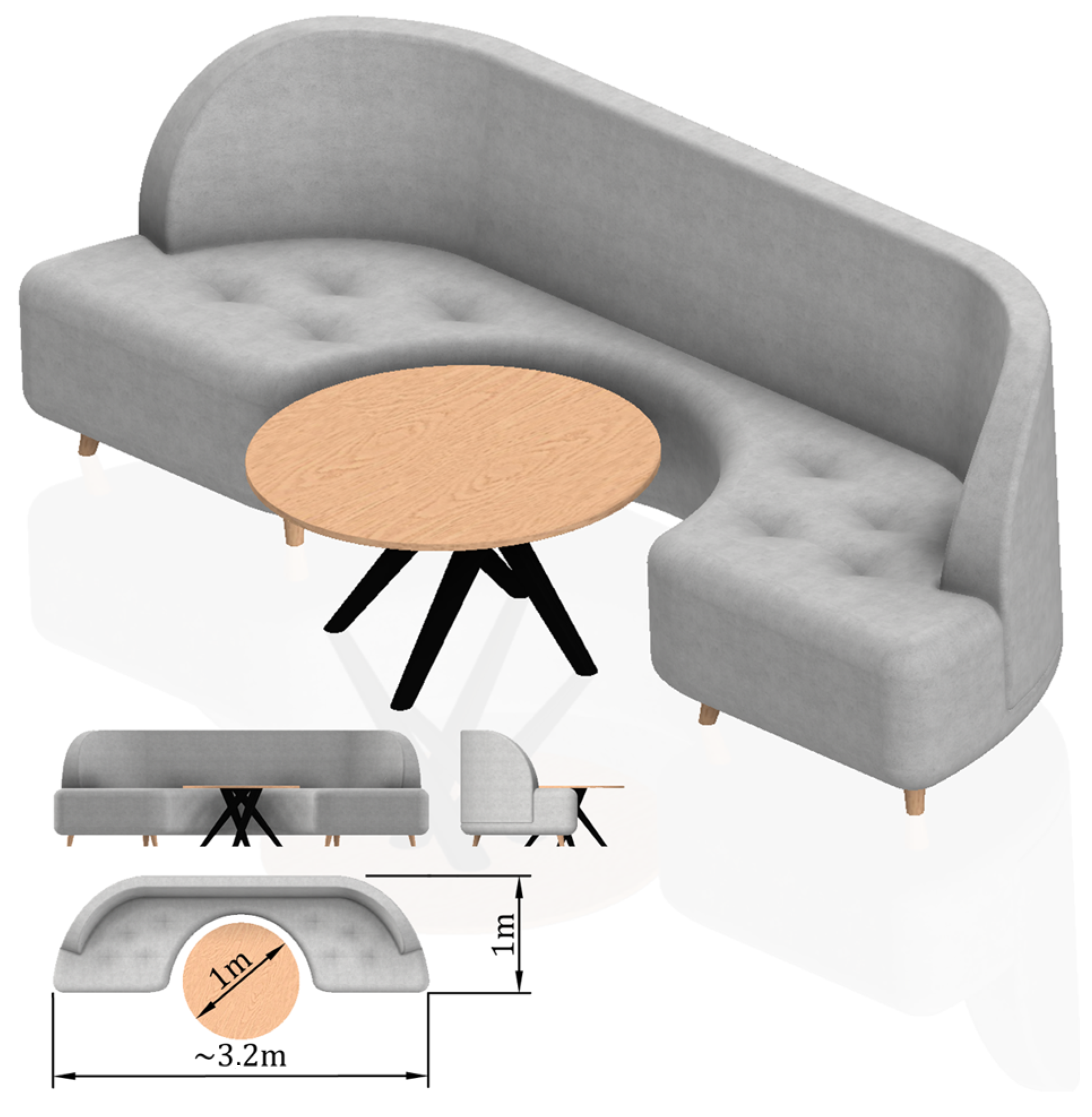
Recycled anecdote from an earlier time this was discussed on HN:
While a student, I looked after the apartment of a friend of mine, who was overseas.
When he moved there, we were _just_ able to eke his sofa around the last corner from the stairwell and through the door to his apartment. Just. After much cursing and several failed attempts.
So, what does a good (cough) friend do while the owner is overseas?
Get some hardwood mouldings/trimmings/whatever you call those long, thin pieces of wood typically put where wall transitions to ceiling or floor and nail them to the exterior doorframes, making both door openings perhaps 3/8" or so narrower, paint them in the color of the doorframe, sit back and wait.
Then, years later, as he is about to leave town, moving company comes along and everything runs smoothly until one item remains. The sofa. Obviously, it got in - so it'll (as obviously) come out.
Only it doesn't.
We (everybody except the owner and the moving guys were in on the joke) managed to keep a straight face for several minutes.
The moving guys even laughed as they (eventually) left, mollified by a bottle filled with a Scottish export product which we'd kept on hand to ensure no feelings were hurt afterwards.
Some friends and I resorted to buying an axe and a bottle of whiskey when we couldn’t get a couch out of our college house. Not OSHA approved and not something I’d want my own kids doing, but we had fun.
My wife owned a condo before we got married and they had moved in this huge sofa. After the sofa was moved in, they did a lot of renovations which made it impossible to get out.
Ended up using a chainsaw instead of an axe but it got the job done. Wife wasnt happy but I was like there is no other way to get this out of here besides in pieces haha.
I'm the same way. A friend of mine bought a new couch because she wanted a change of pace, so I came over to help her. I have no idea how that couch got in. I ended up literally sawing it in half (it was an old, beat down couch) to be able to remove it.
Needless to say, that reinforced by Ikea furniture only mindset until I know I'm not moving for a decade.
If it's around windows/doors it's casing, if it's going around the floor it's baseboard, if it's around the ceiling it's crown moulding, if it's halfway up the wall it's wainscoting.
We use some of these terms in the U.S. too, but they are less common and/or mean something slightly different. Some carpenters and millwork companies will call casing architrave instead, but this seems be mostly used for classically inspired, high end work.
I think I've heard some carpenters call baseboard skirting, but the most common usage of "skirting board" is restricted to the baseboard like piece on the sides of stairs.
We have a term cove molding, but it is a particular style of crown molding.
A rail at 3/4 height we also call picture rail. I don't think I've heard of dado rail though.
I asked my neighbor (USA) if I could borrow his brad nailer to put up some trim board, and he didn't understand what I wanted to do until I explained it to him and he said "Oh, you mean mop board."
Interesting, maybe it's a regional thing - I'm from London.
The category on the B&Q site is called "cornice & coving" so either they mean the same thing or there's a subtle difference in which one is which. Maybe one is plaster and one is wood?
I used to live in a 2nd story studio apartment. I had a full sized overstuffed leather couch. The front door had it's own tiny stoop up a steep flight of stairs, and the front door opened onto a tiny coat closet that made it functionally impossible to get the couch aligned and out the door when it was time to move out. After a solid half hour of getting my ass kicked into my hatband trying to configure the couch in such a way that it'd go out the front door I said to hell with it, grabbed my harness, some slings, and a climbing rope, rigged the thing on a cowtail and rappelled off the deck with it. To this day I cannot for the life of me remember how in the hell I managed to get that couch into that apartment.
I never knew this was a real thing math people studied! I wonder if Douglas Adams knew about it when he wrote about the sofa stuck in the staircase in Dirk Gently's Holistic Detective Agency, or if it's a coincidence.
There was even a computer program in that book that was constantly rotating the sofa, trying to find a way for it to come out. If Adams didn't know about this, he certainly had a sixth sense.
I love the punchline: the computer eventually worked out that the sofa could never have gotten into that spot in the first place. Adams always brought me joy!
The origin story of the sofa is exactly this: furniture items in the St. John's College got trapped upstairs, and if you assume all other things being equal, they couldn't get there in the first place.
The reason was that the furniture was brought upstairs for the staircase remodeling, and the new staircase made it impossible to move it back.
I believe Douglas based it on something that happened to him - though take with a pinch of salt as I can't recall where I read this.
I can believe it though as I had the same thing happen to me - I believe in my case the building had settled (it was always very wonky) and the sofa had sagged taking the result beyond the very narrow threshold that had let me get it in in the first place. A friend helped me saw it in half in the end after I dissuaded him from chucking it out the window; I was on the 8th floor and there were cars parked below so it would have been risky at best.
I'd always assumed the Dirk Gently story had inspired the maths problem, but I see from the Wikipedia article that it first arose in 1966 - so TIL.
One of the earliest tricks I learned with couches is that if it’s shorter than the ceiling then the arms and back form this U.
Sofas used to be great because they were also shorter than the height of a door frame. Now everything is oversized and you need a 10-15% bigger apartment just to have one of each thing your grandparents had.
With the right design sometimes this still plays out on the diagonal.
There is a more general principle, which is that you are in a 3D space and twisting a couch (or whatever) in it will help you find the way through. Sometimes you only need a little space above you to achieve the twist you need.
Also due to the biases humans have with respect to orientation in space, turning the item upside down, back to front or both can also make things much easier.
Lift sofa upright, so i stands on one of the sides. If you look at it from above (like the animations), it’s now an L-shape (U-shape in the animations) with more space to move it around the corner.
If a door opens to a narrow hallway, it may be possible to put the couch upright (making an L shaped footprint viewed from above) and then work it through the doorway into the hall. If it's a really narrow hallway, you may have to continue like that.
I said arms and back (I had to double check I didn't misspeak). The arms stick up higher than the seat. So the concave surface defined by the back and the arms is most of what will limit you getting through the straight edges of a doorway.
There are a few couches where the seat sticking out past the front of the arms causes problems, and a few handrails in stairways that you can sneak between the arms of course, but probably nine times out of ten it's just the obtuse angle between the back and the arms that is your constraint. And that angle plus the rest of the couch around it looks a lot more like the cutout in the linked article than an L. Which is kinda the reason I brought it up.
I’m the “runt” of the litter. I’m maybe 5% taller and my uncles and cousins got the rest.
But it’s the depth as much as the length. I get that a table has to be a couple inches wider so people don’t bump knees but your thigh bone only grows at a quarter to a third of your overall height increase, right?
Couches are just oversized. They’re uncomfortable to get out of if you’re not careful when shopping.
Am I being pedantic for pointing out that that is 3x the normal two generations separating grand parents and grand kids and a height difference of only 6 percent? The only major difference since our grandparents is average weight and expectations of comfort. Correlated but not synonymous.
I think if you’re a GenX or a Millenial the height thing relative to the grandparents is mostly true. And if you’re complaining about how tiny grandpa’s house was compared to today, you’re probably outing yourself as being born in the last century. So it’s a relatively safe bet GP made.
Serious request: can someone please solve this for moving furniture around in 3D? Let me take an AR scan of a flight of steps with a corner and another scan of a couch, and tell me if it's possible to do the move.
Yeah, that’s not much better.
Measuring a couch isn’t too hard, but measuring a corridor in an old building is fraught. Nothing is square and surfaces and mouldings are often curved.
It does not negate the article in any way. This was a mathematical thought experiment and an optimization problem, not about real furniture in real corridors.
> But that was an impossible task: There’s no one formula that can give the area for every kind of shape. (Think about how you use different functions to find the areas of circles versus triangles.)But that was an impossible task: There’s no one formula that can give the area for every kind of shape. (Think about how you use different functions to find the areas of circles versus triangles.)
I don't get it. Am I missing something obvious? I mean, if you have a shape then you can calculate it's area with Green's theorem.
The problem is not to find the area, but to find a parameterization of all possible shapes that fit, ideally a differentiable one so you can simply compute some derivatives to find the maximum.
Back in my first house, we upgraded our bed and triedto move the old bed into the basement. We had a very small hallway with a door leading ti the basement. The mattress fit, of course, because it flexes. The frame fit because I could disassemble it. The box frame, made of iron and wood slats, could not fit. That day, I cut all the wood slats in half, bent the metal, and got that box spring downstairs. Then I but bracing brackets on the slats and unbent the metal. A few years later, we did the same process over again when moving.
may favorite sofa was from Ikea. It disassembled easily. some slots and big bolts took the sides off. then some other big bolts separated the seat from the back. the legs twisted off. now you could carry the two biggest parts, the back and the seat, long and vertical
I'm actually looking forward to doing this with a bed. My prior bed was something I assembled (which I could do gain). Wondering what will work if I want to get a better, e.g. non-IKEA, platform bed. (The mattress will be memory foam so presumably not a problem.)
And this is why modular sofas are so popular now. Whether it be lovesac or another company, sofas these days are coming in multiple boxes and making you do all the work unless you get costco white glove delivery service ;)
It just occurred to me that the optimal sofa looks rather uncomfortable. There’s this narrow bit in the middle, which has very little room to sit on. You can’t lie down on it and take nap.
If you assume it's the size of a reasonable hallway, I think there's enough room for an average person to lie down on either of the halves. At least if the back isn't too thick.
Somehow it doesn’t sit well with me the fact that it’s still quite a complicated shape. I accept that it’s the best one, but I would have expected a simpler shape to be the solution.
A bit like the three body problem, I guess. The problem seems simple because it’s just four walls, but think how complicated the constraints are once you have an arbitrary shaped sofa: you shave a tiny bit off one corner, and now you can translate the sofa in one axis a little bit or rotate it a little bit. But all the other points in the sofa are potentially limiting that movement, in complex ways because they might be curved. You get stuck, so you shave a tiny bit off somewhere else and suddenly all the constraints have changed again depending on the cut you made. The optimal shape is rather elegant, I think, because it’s basically the half-donut shape you’d expect but with some very limited perturbations that gain a tiny bit of area during key transitions.