It's easy to find "real brands" if one looks outside of Amazon, Alibaba, etc.
Surprisingly, I find I am more pleased with purchases I make outside of Amazon despite all of Amazon's perks. "Platforms" like Amazon and fake "brands" aside, online retailers that only sell "real brands" are still around; they never disappeared despite Amazon's meteoric rise. Many sell through Amazon but also sell outside Amazon, too. Some do not sell through Amazon.
Being born before the internet existed, I started ordering products delivered by mail in the catalog era. I am biased toward locating "real brands" that have built reputations for high quality. I miss these brands. I loved the transition from catalogs to websites, but it seems like in the last 10-15 years fake "brands" that can offer no promises whatsoever have been killing off the motivation for having real ones that guarantee high quality.
When I went to Shenzhen I found some of these brands with stalls in their vast malls. They're real places. As you walk through you navigate around an obstacle course of dollies, hear endless packing tape and occasionally point out, "oh look, there's Owawuwo, I got a cheap projector from them".
Americans can get a Shenzhen-only 5-day Visa on arrival (VOA) from Hong Kong through the Luohu entry at the LoWu station via the regular MTR. Don't take the HSR, they do not offer it there and you will be turned away. You Must go to the office at Louhu station, it is the only way. It's easy, just take the metro.
Anyways, at LoWu it takes about 45 minutes after doing the paper work. It was very easy. Visa approval for Americans this exact way is estimated to be north of 98%. Exchange your HKD at the government run forex up stairs in the mall after entering China, it's a 1.5% commission, best I've ever seen. Then pay in cash - your Western credit cards Will Not Work. It is a fairly easy day trip - about 45min from Kowloon by rail. The 5-day Visa is a Single Entry.
To go to the trading district take Luobao line (#1) to Huaqianglu (3 stops). It's a 10 minute train trip or a fairly uneventful hour walk if you're up to it. English at the trading district and the border mall is ok. Everywhere else, not so much.
Recommended. The place is absolutely bonkers.
They have this wildly intricate culture of price bargaining. If you're looking to actually buy stuff, you can get amazing deals. But I just went as a tourist.
I went a decade ago (on a standard tourist visa, was easy to get but I had to plan far ahead ). It was neat, but I wouldn’t say it’s a must visit, or a top 5 Chinese destination.
The one cool thing was seeing new products at Shenzen, and then a couple months later starting to see those products in American retailers. Seeing the markup and the flow this way really opened my eyes to how the American consumer is exploited.
Sure but if you happen to be in Hong Kong, which you can just fly into as an American with a standard passport, and you want to go to Real China and didn't bother with the Visa interview, then you actually can with this "one weird trick"!
It's certainly a hard border, Shenzhen is as China as Tijuana is Mexico. So if you're in HK and have a day to travel around, give it a go, it's a fun adventure.
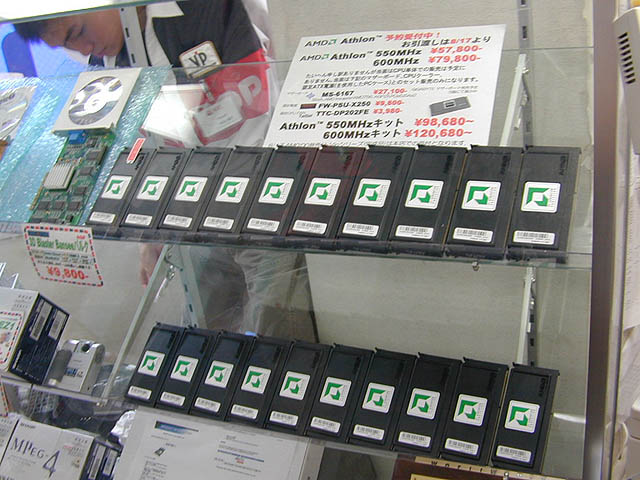
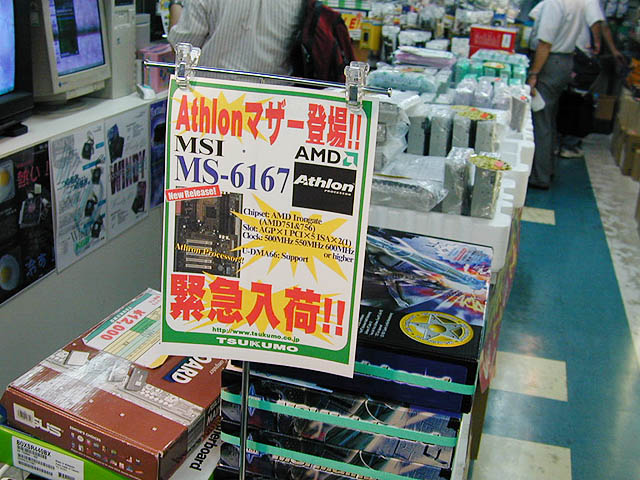
>"AMD Athlon 500-600MHz (bulk) price display. The product is scheduled to arrive in mid-July, and reservations are being accepted. However, there is no specific arrival schedule for compatible motherboards yet."
>"the K7 revised "Athlon" has been given a price and reservations have also started. The estimated price is 44,800 yen for 500MHz, 69,800 yen for 550MHz, and 89,800 yen for 600MHz."
>"AMD's latest CPU "Athlon" will be sold in Akihabara without waiting for the official release date on the 17th is started. All products on the market are imported products, and 3 models of 500MHz/550MHz/600MHz are on sale. The sale of compatible motherboards has also started, and it is possible to obtain it alone, including Athlon"
> It's easy to find "real brands" if one looks outside of Amazon, Alibaba, etc.
You have to be careful, though. There are a shocking number of legit-looking brands with their own sites that are just drop-shipping the same stuff, at an enormous markup. My wife found a piece of clothing she liked for $60; a quick image search found it (with the exact same images) for $8 on Shein. Nice hustle, if you can make it work.
> after he posted a video on social media titled "MADE IN AMERICA!" in which he said "he could conceal the fact that his shirts are made in China by ripping out the original tags and replacing them with tags stating that the merchandise was made in the United States".
I've found I buy fewer things in general, and also the things I do buy are of higher quality when I do it in person. Might even get some useful advice if it's something like a tool. Also it's just more fun, especially if it's a nice bike ride, walk, or trip on transit.
> And go out to get an envelope because I'm going to have a hell of a good time in the process of buying one envelope.
My girlfriend needed a humidifier last week. Walmart, Target, Home Depot, and Lowe's had mostly the same 2-3 brands of single-room humidifiers, most of which were no-name companies that apparently "specialize" in humidifiers (i.e. were spun up to be a shell for selling cheap humidifiers). We found one Honeywell branded one on sale and went with that since it's a legit brand; it was defective (lots of reviews online having the same issue), so we had to return it and make a decision between Walmart's Equate brand and one of the no-name ones from Target. She wasn't sure if she wanted a larger or smaller version of the no-name one, but we ended up not having an option because the Target shelf was empty of the smaller ones. Home Depot had the same model for $10 more, but we were at Target anyway because they at least had her second choice for color, while Home Depot only had her third.
In-person shopping has become just as crappy as online shopping, with a lot of the same problems regarding quality and brand control. The only difference ends up being less options (which could make the experience less stressful, except the options are usually presented in some form anyway, they're just not available, which makes it frustrating). It's largely thanks to big-box stores, but it's not like someone can just up and start a small shop to sell a particular niche of product (let alone all products) with higher quality as easily as you could with a website.
Big consumer brands haven't meant anything for a long time. Honeywell and GE among those. They all sell their name to other manufacturers and have been doing so for decades. The best thing you can do is keep the receipt and make sure you follow up on returning it or getting warranty service if it breaks in those timeframes. It's really not worth even trying to do the research on things that are less than a hundred bucks. Buy something that looks nice, tape the receipt to it, and return it/warranty claim it if it acts up.
On the flip side, I cant find an ice scraper or a pair of snow / ski pants in December in Wisconsin in any store so the only avenue I have left is order on amazon since the other marketplaces are far more expensive. Depends on what you're buying I believe.
As far as tools or other general hardware - the stores like mom and pop 100 year old hardware stores are amazing and have things you probably cant find online sitting on some shelf and the owner knows exactly what box its in. I love that experience.
This is why I have a bunch of stock in Shopify. It's slowly started rolling out discovery features in its Shop app that federates its stores. I try to limit my use on Amazon to things I know can't be faked and things that are so much cheaper that I can deal with it being fake. My purchasing trends have definitely moved toward the edges - aliexpress for chinese stuff (that would normally be on Amazon) and Shopify for "buy it for life" stuff.
I'm going to genuinely miss the bicycle headlight I have bought under like 4 different brand names. I won't miss the 36 other grotesqueries sold as alternatives and produced by the same business and manufacturing environment, but I'm also not excited about having to choose between 6 $50 lights of similar quality that are locked to a GPS company's equipment. It would be great if in 10 years I could get a similar light for 25% more than the current price adjusted for future inflation. But there's no reason to believe that tariffs are going to make American products better, just that it makes the cheap products American. And there's nothing else about Trump's (or for that matter his Democratic counterparts'-) industrial policy to encourage that either.
15 different variants of the same product, all obviously cheaply made from the same factory, with varying degrees of quality control and reviews strewn about the various “brands” of the product so that it’s much harder to have a negative review everywhere.
Yeah, this sucks. Though the correct thing to do here is to enforce this hygiene on the platforms themselves. They have every resource and means to be able to prevent this kind of thing from happening. It’s just more profitable for them not to
There are flecks of gold in the midst of all that dirt.
I needed to make a 3/4" hole in a 1/8" thick mild steel angle to repair a cart. Didn't have a drill bit that size and quickly realized that a hole saw would be a better choice. Off to Amazon. After some browsing, found the same 3/4" carbide-tipped holesaw from a million resellers. Found a package of two for $13. Following the logic of "even if they only last for one hole, it's still cheaper than buying a good drill bit that I'll never use again", I ordered it. Item arrived and it looked as cheaply made as the photo!
But what do I have to lose? For $13, it's worth a shot.
Chucked up the holesaw, dripped some cutting oil on the metal and went to work. Fricking thing went through the steel like it wasn't even there. I was fully expecting that the teeth would chip off and go flying about halfway through, or it wouldn't do crap and the metal would work-harden, making my job even harder or worst case, the entire flimsy-looking thing would shatter (I have excellent safety glasses BTW). No, about 1 minute later I had a nice clean 3/4" hole with perfect edges that didn't even need deburring.
That led to the first Amazon review that I ever wrote: I was that shocked at how well it performed. Turned on my (Amazon-bought) stick welder and finished the repair.
I think the key is to have a sort of risk framework. Things that handle data, are a fire risk or are direct knockoffs avoid.
Otherwise it’s often a good value, and sometimes the “brand” name is really the knockoff with a trademark on the box.
The carburetor on my leaf blower failed and needed a rebuild. The “name brand” kits were $40-60 at Home Depot and Lowe’s. I got some random kit on Amazon that was the same main part, with a different (and better) kit of tubes, etc than the retail one.
Same thing with clothes. I’ve had great luck with workout clothes, my girlfriend did well with dresses and other stuff. Just be smart about it — $10 jeans are gonna be garbage.
I ended up drastically cutting back on Amazon purchases when they started getting flooded with brands like that.
Its absolutely on Amazon to maintain quality. There are certain brands and types of products I'll order there because they're just harder to find otherwise, but its mostly a last resort these days given that Amazon doesn't care to curate what is on their "shelves".
If the quality sucks (or at least doesn't match expectations), return it. Shipping is fast and returns are easy. The vendor takes the consequence of the return. Rarely do I buy product that has subpar quality that I need to return it. Just do your research.
Hah, well easy may be in the eye of the beholder. The closest dropoff for Amazon returns is about a 20 minute drive, its a CVS that has lost one return I tried to send back. I often don't leave our farm more than once a week, mailing off a few returns a year isn't a big deal but I don't want to make a habit of it.
My research, and experience with Amazon, just left me avoiding it when I can. That's not always possible and there's plenty of good stuff to buy on Amazon as well, but 2 day delivery can mean a week here and returns aren't as simple as dropping it off a block from an office in the city.
I love it in terms of consumer experience. I like several products from AliExpress and the like, but sometimes find they're available for the same price or cheaper and faster with better customer service from Amazon. I don't care that they have generic brand names in either case
I'm with you. I don't really understand the complaints, since Amazon's return policy means that you aren't really taking a risk when you buy, even from randomly-named brands.
That rather depends on your ability to evaluate what you get. I have no qualms telling non-technical people "buy USB-C chargers from the Apple Store", knowing perfectly well what quality I will get. However, you can't even guarantee you'll get something genuine from Amazon anymore even if you select that exact same product.
Exactly. And most people think, "well, I'm super technical, so I'll know," but that only works for your own field. I can tell if a USB-C charger is genuine or not, but I know that I don't know enough about clothing irons or magazine sleeves or a hundred other items to tell if it's crap or not within the return period. Sometimes, I may never know if I don't try a different one for an extended period of time.
It only shows what people are buying, not what they want to buy. Cheap crap might sell a ton because it's cheap and listed at the top of the search results. Which then feeds into it being kept at the top of the search results. A lot of times if the item is cheap enough people don't bother with returns and rather just throw the item out, something that will go completely unseen by the metrics.
Ratings are also not very helpful because they are manipulated in a variety of ways. Things like bots/mechanical turks, putting offers in the package to give people money back if they rate the item 5 stars, or hijacking a well rated product listing by changing it later or taking advantage of item variants system.
So, I very much don't trust any of their data myself.
> putting offers in the package to give people money back if they rate the item 5 stars,
I had something similar but more convoluted happen with the car mount I got for my phone. The box included a card stating to email them to sign up for their warranty. Emailing them signed me up for their loyalty emails, which are infrequent enough that I actually didn't mind them. The loyalty emails frequently included offers of "free gifts." One day, I actually replied to one asking for it, and they explained I'd be buying it from them on Amazon and then they'd pay me back for it-- in exchange for a review, of course.
I'd had similar things offered to me as a YouTuber with companies wanting "reviews" but making me do the purchase myself (I've done one or two of them). The fact that it's just being offered to mainstream consumers now is ridiculous. It means you can't trust any of the reviews (or at least the positive ones; I normally look for negative ones with photos these days).
I don't think its so easy to pull apart what people are buying and what they want to buy.
Amazon has a pretty crippling hold on the online retail industry, and they collect massive amounts of data to decide what to put in front of people.
Targeted marketing and the partnership between marketing and psychology is nothing new, it has gotten stronger though. I have a hard time looking at a market run like that as a roughly free market where the successful products indicate what buyers actually want rather than what they were best coerced (or "nudged") into buying.
I would say there are other viable platforms people could offer on but Amazon actively punishes people for trying to work out of their ecosystem by penalizing them for offering lower prices than on Amazon
It's an optimization loop where one part of the cycle (showing people stuff and seeing if they buy it) is very fast, and one part (product development) is very slow. This is sure to find local, rather than global maxima.
Yeah, and it's not even necessarily a problem with the product itself. Sometimes I do want something cheap and disposable. The problem is that you have roughly zero information about the retailer, and manufacturer, and anyone in between. If one product listing gets bad reviews, someone can spin up 5 more listings with slightly different metadata. It's effectively a Sybil attack against the reputation system of the market.
> I was very pleased with my "[brand name, if applicable] toilet seat, (2-pack), premium pure white, toolless installation", that I purchased for my family. Would definitely recommend it to friends and family. It arrived promptly and was in perfect condition. You exceeded your current quota please check your plan and billing details.
The above is similar to recent reviews I've seen.
It's infuriating that there is a reliance on user reporting to find and report COMPLETELY OBVIOUS fake reviews on Amazon. A great example of why competition is necessary, and not just from one other entity equally interested in allowing the others existing to avoid being a "monopoly"
I got one of those "leave us a 5 star review for a coupon" and I had just enough of it. I left a 1 star review indicating that they offered a coupon for a good review.
My favorite is all these letter-soup Firewire-to-USB convertors which are just glue and random wires inside and are either completely inert or disastrously damaging to your peripherals:
I literally got a Firewire to USB converter yesterday to try and pull video off a DV Camcorder. A video capture card in the same price range had worked great for letting me stream VHS tapes through OBS Studio.
There are various YouTube videos showing a daisy chain of Thunderbolt 3 to Thunderbolt 1/2 adapters connected to various Firewire cables and adapters. I was hoping to avoid all of that but the camera doesn't show at all. Fortunately, nothing seems damaged on either side.
I've only got 6 tapes so I'm sending them off to a service and sending the adapter back to Amazon.
You may get rid of that, but it's still Amazon. Just recently, they fuzzed all their search results further, so when you search for something, it will give you lots of stuff you didn't search for. Similar to how Facebook Marketplace does.
I think the only way to avoid disappointment is to avoid Amazon altogether. Their customer experience is extremely deceptive and engineered to make you spend the most money. From the featured searches all the way to how it charges you paid shipping instead of free at checkout.
We should all feel burned enough at this point and stop rewarding them. Bezos purchased the Washington Post for all this money, and he won't stop there.
You are right, I did read the article but I missed the parenthetical (assuming the article was not updated, imagine). My point was that the commenter was complaining about Amazon "alphabet soup" names which is not relevant to this. There is a very specific reason those names are used. It's a very interesting story about follow on effects.
it's the whole point of the tariffs. China does an end run around all of our laws, consumer safety, human rights, workers conditions, intellectual property, all that, and in doing so they cut costs and beat domestic companies at the market. Tariffs are a tax we charge to represent those things they have immorally refused to do while participating in our market.
A country can't effectively have things like a minimum wage while allowing completely free trade with countries that use slave labor and don't share your values, because they can beat you on price by using human suffering as a competitive advantage, and put you entirely out of business.
What zamalek describes isn't just that China manufactures cheap products. The complain is more about retailers or marketplaces (particularly online ones) that encourage essentially anonymous, zero-cost seller accounts and product listings.
Traditional retailers like Target or Costco also sell a lot of cheap Chinese stuff, but they don't have quite the same level of junk in their listings.
Right. There's always been a range of products from cheap to quality. But "cheap" used to mean something that wouldn't last as long or that had limited features, but that could still be worth the lower price. Now "cheap" can mean something that will break the first time you use it, at which point is any price low enough?
I bought a garden hose sprayer at Dollar General for $1, and it leaked immediately. $1 is so little now that it was basically free, but even for free it wouldn't have been worth it, and I'm not going to make a trip to get a $1 refund. At some point, "cheap" is so bad that it has negative value, as it only adds clutter and waste.
Do you mean this is the point of a carefully planned, deliberated, executed, and announced tariff rollout, or do you mean that's the whole point of tariffs as they are currently being implemented in the United States?
The tariffs that were announced during the campaign - the same way Ross Perot did - and the reasoning was to bring us manufacturing back to the US and reduce the tax burden on US citizens? Such as writing off car payments if the car is American?
People wigged out over non-reciprocal tariffs, where we tariff at 50% what they charge the US. People wigged out at 10℅ flat rate tariffs. "Heard island penguins get charged 10%!)
I really have to wonder how important this Chinese junk is. They make so much junk for the US, that the EU, including Von der Lyon, had to make a plan to deal with Chinese companies wanting to, and I quote here, "dump" all their exports on to the EU market.
The EU is very protectionist over their countries' economic outputs and manufacturing. But if the US does that...
> People wigged out over non-reciprocal tariffs, where we tariff at 50% what they charge the US.
The "reciprocal" tariffs are based on not the tariff duties foreign countries imposed on US goods, but the trade deficit the US has with said foreign country. There's a lot of idiocy in the tariffs, but this was one of the loudest complaints people had with them.
> People wigged out at 10℅ flat rate tariffs. "Heard island penguins get charged 10%!)
Because the list of "countries" being charged made it clear that it wasn't being based on a list of countries as people understand them. Uninhabited islands and islands consisting only of US military bases being on the list were strong signs of the lack of competence in the planning for the tariffs.
And really, that's why people are complaining so hard: it is abundantly clear that tariffs are being rolled out in a botched manner by incompetent people for inane reasons, so whatever positive effect they might have is completely ruined and all of their negative effects are intensely amplified.
I don’t think anyone is claiming there’s secret industry on the islands. But a “data error” is probably understating it, that is what did actually appear on the bills of lading. Whether it was a bizarre innocent mistake or sort of some kind of financial scheme is unclear.
Maybe. That’s clearly the likely case for Norfolk.
Do you know if tariffs are assessed based on the country of origin in the bill of lading? The Guardian article doesn’t answer that question. I’d suspect so since that’s how everyone is counting imports and exports, but the Guardian article isn’t clear.
The USA and the EU more or less have had even import duties. The USA averaging out at 1.47 % and the EU at 1.39 %. [1]
The EU has been advocating for a free-trade agreement, the TTIP, with the USA from 2013 on. It was buried in 2016 by the 45th president of the USA, who somehow thought it unfair. The EU has proposed a free-trade agreement only a few weeks ago. [2]
You may believe what you want, but at least in dealings with the USA the EU has always promoted free trade. Even Fox News acknowledges that ;)
Hold on now. For consumers, the only thing that's mattered as far as we're concerned is the fact the US had de minimis, which effectively meant no duties paid on all relevant goods a US consumer might want.
The EU, on the other hand, has made buying goods from the US, for consumers, horrifically expensive, including reducing the value of non-duty paid goods to essentially zero and leaving it up to EU member countries to decide if they then wanted to charge an additional "inspection fee" often more than the value of the goods themselves. Spoiler: those countries did.
So, your point isn't really relevant from a consumer point of view. The EU and its member states have tried every dirty trick in the book to make it as awful as possible to buy anything from the US.
If readers believe I am making false claims, please engage with me. I live in Denmark, as a Dane, and this is what I and any Dane who has bought goods from the US, has experienced directly.
The actual, lived experience is far different than whatever any bloc or country may claim (such as being in favor of free trade). The EU has always been economically protectionist, since its birth.
For those not in the know (and too lazy to look it up ;)), de minimis rules for customs duties set a threshold below which no import duties are applied. The de minimis threshold for the USA used to be 800 US$ (and for now continues to be for all but imports from China), the de minimis threshold of the EU is 150 EUR. In other words, if you import goods worth less than 800 US$ into the USA from the EU no duties are applied. If you import goods worth less than 150 EUR from the USA into the EU, no duties are applied.
There is also a tax de minimis, which is a threshold when you have to pay sales and possibly other taxes, e.g. luxury, alcohol and so on. Obviously those taxes differ from country to country in the USA and the EU, and, for example, importing bourbon whiskey into Denmark would be more expensive than into Germany because of the way alcohol is taxed. But the de minimis determines when those taxes even apply. The USA leverages those taxes from a threshold of 800 US$ (again, not any longer for imports from China), while most EU nations set this de minimis threshold to 0.
Merchants usually combine all these costs (duties, taxes, fees, insurances, shipping, etc.) into something called the "landed costs" [0]. Relevant taxes and fees are higher in EU nations than in the USA, which explains most of the differences, but you are quite right, the WTO considers the USA's landing costs fairer than those of most EU nations (Germany is especially bad.) I have no special insights but I guess this is because Intra-EU trading is devoid of duties, fees and taxes (it is a free trade zone after all).
If you want to poke around a little in the various trading nations of the globe, [1] has a nice database available.
So, I do not agree with your conclusion that the EU is a protective lock box, but could improve. Thank you for pointing this aspect out. It is easy to forget about nuance and how complicated and convoluted some of these things can be.
You've done a good job of explaining the relevant de minimis rules, but you've deflected or minimized the EU's fault.
Inspection fees, duties and taxes make it so functionally no Danish consumer bothers to purchase goods shipped from the US. For Americans to then come rushing to our aid when us poor Europeans are getting a dose of what we've been giving for decades is ironic, to say the least.
When i wanted a DVD player, the cheapest near-mint one on ebay, including shipping, that had digital audio out was shipped from the UK, to the US west coast. This was ~25 years ago.
I ended up trading it for a Volkswagen Jetta. unrelated, but quirky.
This seems to assume that everything can be imported or acquired domestically. But tariffs implemented in other countries are much more specific. It makes sense to use tariffs when you have the capability to meet your domestic demand with domestic supply. Indiscriminate tariffs catch things where demand far exceeds domestic production, whether that's raw materials, specific foods, or things that will take a long time to ramp up production domestically.
Ultimately, lots of things manufactured domestically will still increase in price because of the raw materials they require.
well to be fair to parent, the tariffs weren't exactly rolled out in a sane fashion and a lot of credibility was lost along the way, though it certainly was entertaining if you're a sicko like me.
The main purpose of tariffs is to change behavior for both the consumer and the manufacturers.
Auto manufacturers have been doing this for decades when the US started imposing tariffs on Japanese manufacturers back in the 1970's. To get around the tariffs and still get access to the US markets, they would simply assemble the parts of the cars here and bypass the rules of the tariffs. Many companies then started doing the same.
This effectively changed the behavior of the companies to avoid the tariffs. The end result was more manufacturing and assembly plants here - even though most of the big production tasks of the vehicles were still done overseas.
Also, there's already been several announcements of companies moving their manufacturing to the US in order to avoid getting hit with tariffs:
Nvidia (NVDA) on Monday said it will produce up to $500 billion of AI infrastructure in the US within the next four years as the tech industry looks to bolster its domestic manufacturing footprint in the face of Trump's approach to trade policy and desire to onshore more US heavy industry.
Also, Ford made some moves to avoid both US and European tariffs:
Less than a week after the White House announced its comprehensive set of tariffs, the Dearborn automaker exclusively revealed to Ford Authority its comprehensive plan to relocate all of its assembly plants to Hawaii. The move will be made possible by state of the art 3D printing technology and has the support of the United Auto Workers.
In any event, Ford envisions Hawaii as an export hub for markets outside North America and a key pillar of the company’s domestic production capabilities. Ford will utilize an obscure maritime law from World War II as a way to get completely around European and Asian tariffs, as the original intent of the legislation enabled private companies to avoid punitive trade measures to get badly needed supplies to the Allies at the height of the conflict.
Ooooof. They got me. Ironically, this is the first article in many different search results with several other articles about how Ford will deal with the tariffs. With another article from Ford Authority on the same topic:
In addition to scrutinizing its supply chain, Ford is also in the process of stocking up on parts that comply with the current U.S.-Mexico-Canada Agreement, and it’s also taking a second look at its operations in those countries, according to Automotive News. Ford is “strategically stockpiling components where it is cost-effective and parts that are not pending engineering changes,” supply chain chief Liz Door told suppliers in a recent memo.
This is what got me. They had this article talking about looking at its operations in those countries and then the April Fools article which essentially described them doing just that.
Although I already knew Ford does most of its manufacturing in the US, I should've known better.
Instead of the US government spending away on overcapacity so Canadians can have cheap products, that money should go to public housing and healthcare subsidies. I think this is better for the US long term because agriculture is heavily subsidized and competes with housing and other industries for land and labor.
Oh yeah the money from the tariffs are definitely going to go to help average Americans. Oh wait be did this last time and 90% of the tariffs went to propping up all the industries that went to shit due to reciprocal tariffs (soy beans and others) and we never recovered. So many countries moved away from us and never came back. That's exactly what's going to happen this time, alienating is from our allies, almost like it's the point to cause chaos and alienation but wait why would trump do that hes always been on the up and up before
I don't expect an insurrectionist to do good for Americans.
I also think government spending on overcapacity so we can export food is a waste of money and bad for the economy and the environment. How many millions of acres of soy bean crops do we actually need?
If the market for exported soy suffers because of who people voted for, let's reduce the subsidies by n%, farmers will plant less won't be able to keep all their land and we can return that land to Native Americans. This is disruption we need (but won't get because murica).
They can substitute US products with those from plenty of nations plowing money into overcapacity and dumping their exports on the international market.
The tariffs were definitely part of the campaign, described in detail in Project 2025 and will eventually replace higher brackets of the income tax.
This consumption tax is tax policy, not trade policy. That was evident when there was not even any discussion about excepting manufacturing inputs (neither this time nor the 45th administration).
> A country can't effectively have things like a minimum wage while allowing completely free trade with countries that use slave labor and don't share your values, because they can beat you on price by using human suffering as a competitive advantage, and put you entirely out of business.
Australia (I live there) has free trade, a high minimum wage (USD$16/hr) which is strictly enforced, no tariffs to speak of, and used to share the same values as the USA (in the last 100 days no so much). Australia has been that way for decades. In other words: your wrong, despite what "common sense" might tell you.
There are far more glaring examples, like Singapore. Almost no natural resources to exploit, no tariffs to speak of, and a median yearly income of USD$66,000. The USA's median income is USD$40,000.
Now look at countries with high tariffs, or even just "higher than the USA used to have" tariffs. All of them, and I do mean off of them, including China, have living standards well below those with very low tariffs. So you are not just wrong. Empirical evidence says you have it completely arse about.
after 50 years of de-industrialization in US, it's a sad fact that US can no longer produce most of those items, yes it's totally gone. It will take a few decades to rebuild, if possible at all. For now, whatever those junks are at Amazon, there are not many options to procure them elsewhere.
Build essential stuff locally, not junk of course.
Or else the virtual economy can not sustain forever based on borrowing money while producing very little locally.
This weird demoralization has to stop. We went to the moon in less than 10 years from beginning the Apollo program. It’s less than 10 years to build a nuclear power plant on average. We deployed the COVID vaccine worldwide in less than one year. Manufacturing is not that hard. If we want to do it, we can do it and we can do it quickly.
True. The biggest impediment to increased manufacturing is the pile of onerous regulations, many of which were created by the stroke of a pen since 2008, and which can be removed by another stroke of the pen.
Do you have any substantiation for either the point that onerous regulations are the primary impediment or that most of these have been created since 2008 (by fiat or otherwise)?
It's always going to be cheaper to make things in places where labor costs and environmental responsibility expectations are low.
That's why the manufacturing companies did it. The politicians allowed it because it was meant to make the world more peaceful and prosperous. Which it did, really.
I can see how hitting the EU with tariffs is going to improve human rights ... oh wait.
But on a more serious note, tariffs could have been used for what you are saying, and it would have been a beautiful thing, but I think we can agree that's not what's happening here, can't we?


That would be one silver lining in all this mess, at least.