>The way you're describing the theory sure seems like the Ensemble Interpretation to me, but to be honest, I have never heard of the "Statistical Aggregate Interpretation".
yes, my mistype, it is basically Ensemble Interpretation.
> However, the probability density you gave for the frogs in the classical case, cos^2(pi*X/A), is incorrect.
it isn't resulting probability distribution on the wall. It is probability distribution of the frog legs touching the ground on a radial line from door to the wall, i.e. peaks at 0, A, 2A, 3A,.... It is about the same as position operator for electron would produce on a radial line from slit to the screen.
Also note that the frog doesn't interact with the wall if the frog is "airborne" (i.e. one can imagine that it just goes through the wall without leaving a wet spot or even better - the wall is too low, say 0.1m , so airborne, mid-flight, frogs would fly over it).
the red concentric lines is where a frog most probably touches the ground and the greenish-yellow - where a frog is most probably mid-jump airborne (flying at the height enough to fly over the wall). Where 2 yellow-greenish lines intersect right near the wall - it is the place with minimal probability of a frog landing near the wall, ie. dry place. While intersection of 2 reds - correspondingly a very wet place.
>The fact that electrons in Hitachi's experiment display a "many-humped" distribution is good evidence that the electrons are not following the same rules as the frogs, and hence that the electrons are behaving non-classically.
this non-classical behavior is the quantization of position, ie. position probability density looks like concentric waves starting at a slit. I.e. cut along the radial line, the profile of that density is a correctly scaled cos(x), with x - distance from the slit. The superposition isn't necessary for the observed effect.
>> in Hitachi experiment it is shown explicitly clear that quantum interference is emerging only for multiple particles.
>This is the exact opposite of what the Hitachi experiment shows. The experiment is interesting and surprising precisely because particles are sent one at a time but still show an interference pattern. The experiment shows a single particle interfering with itself.
i'm trying to understand where do you see the interference of a particle with itself. Lets say the experiment was run only until there is only 1 (i.e. 2 sec into the clip), or say 3 particles hit the screen (4 seconds into the clip). What would be an indication of the interference in such a case?
Ah, I see. Yes, I did misunderstand the mechanics of your frog thought experiment. However the math for the classical case still doesn't work out the way you need it to. Setting up the mechanics the way you did, you will not get the probability distribution you mentioned on the frog's radial distance from the wall. Nor will you get many alternating wet and dry spots on the wall, even allowing for frogs to jump through the wall. I encourage you to try the math yourself or to set up a Monte-Carlo simulation to estimate the classical consequences of your jumping rules.
If you're not convinced yet, consider the following:
What happens if Hitachi's experimental setup had only one path for the electron to follow rather than two? You're claiming that the frogs are a good model for Hitachi's setup, so it should be the same result that you claim for the frog model with one door. You're claiming that the frog model with one door produces a pattern of alternating wet and dry. What happens in the lab when you try it with electrons? Electrons following a single path don't produce an alternating pattern; they produce a pattern very close to a Gaussian.
Moreover, here's the really wild part of the experiment. If you let electrons go through either just one path or just the other path, you'll get nice smooth Gaussians from both (translated a bit from each other). But open both paths up, you'll see the distribution dim at places. That's very unexpected! Somehow letting more electrons through has decreased the electrons hitting certain parts of the screen. And if you carefully observe your experiment, you'll see that some other areas of the wall more than double in intensity when you open up both paths. It's pretty clear that you'll never be able to invent mechanical rules for classical frogs that can mirror these experimental results.
> i'm trying to understand where do you see the interference of a particle with itself.
This is a slightly subtly distinction, and it's easy to miss what's going on. You "see" the effect of a particle destructively interfering with itself when there's only a single electron on the screen. You "see" the effect in the probability distribution for where that electron appears, but you can't say with high confidence that this is a real effect until you've seen a statistically significant number of particles. But the effect had to have been there the whole time because destructive interference happens independently and individually on each electron. If you still think there's some effect being transmitted between different electrons, then realize that the fact that all the electrons are showing up on the same screen is just a convenience for the experimenter. You would get exactly the same effects by setting up a statistically significant number of screens all spatially separated from each other and running the experiments without signals being able to be communicated between screens and then overlaying the resultant observed positions.
However, the Mach–Zehnder Interferometer is, I believe, an better physical model to witness a single photon interfering with itself. Young's double-slit experiment was invented first, so for really that reason alone, it's taught first, but because of its continuous nature, it's easier to get bogged down in certain irrelevancies. The Mach–Zehnder Interferometer is really much more plainly impossible in a classical universe, or an ensemble interpretation universe for that matter.
> Nor will you get many alternating wet and dry spots on the wall, even allowing for frogs to jump through the wall.
...
>What happens if Hitachi's experimental setup had only one path for the electron to follow rather than two? You're claiming that the frogs are a good model for Hitachi's setup, so it should be the same result that you claim for the frog model with one door. You're claiming that the frog model with one door produces a pattern of alternating wet and dry. What happens in the lab when you try it with electrons? Electrons following a single path don't produce an alternating pattern; they produce a pattern very close to a Gaussian.
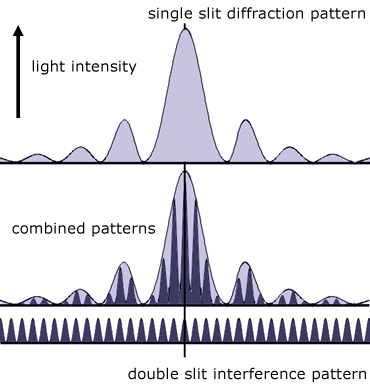
The electrons, photons, and frogs (jumping over the wall when probability below some threshold) would produce an alternating pattern like this one:
Because it is result of the same geometry as on the image that i posted before : where 2 greens touch the wall simultaneously - deep trough, zero intensity, and where 2 reds - peak. The meaning of the green/red isn't important - be it probability of a frog's legs touching ground or the probability density of position of electron - the resulting pattern is the same. The image can be interpreted as either while it is just an image of concentric circles originating from 2 points. Gaussian outline comes to play only because it describes the normal deviation of a frog/electron from the preferred direction they jump/fired along.
> If you let electrons go through either just one path or just the other path, you'll get nice smooth Gaussians from both (translated a bit from each other).
this is true only in classical mechanics where position of electron or a bullet isn't quantized - you'll get a smooth Gaussian. In QM, i.e. real electrons, photons (or jumping frogs having the property of going through/over the wall where ground touch probability is close to 0) single slit produces dim/light pattern like on the image above. Like the double-slit pattern, this single-slit pattern is also result of position quantization.
> But open both paths up, you'll see the distribution dim at places. That's very unexpected! Somehow letting more electrons through has decreased the electrons hitting certain parts of the screen.
This - double slit is more frequent than single-slit or dimming at some places - happens only for stream of photons as photons interfere with one another and the photon's wavelength is the same as its position quantization period (note - for electron DeBroglie and positional quantization are different wavelengths), so the photon_A-photon_B interference is visible on the scale of the pattern produced as a result of positional quantization. In case of Hitachi, we have single electrons, so no electron_A-to-electron_B interference, so the double-slit pattern is less frequent than single-slit, ie. where was light on single slit - there will continue to be the same or brighter light on double-slit, it is just some (not all) troughs/dims will disappear.
> You "see" the effect in the probability distribution for where that electron appears
The quantized position probability distribution already explains the pattern. I don't see how adding the interference or superposition changes it.
>If you still think there's some effect being transmitted between different electrons
no, the many particles, i.e. many samples is just results in better visualization of underlying probability distribution. I think here we agree.
> You would get exactly the same effects by setting up a statistically significant number of screens all spatially separated from each other and running the experiments without signals being able to be communicated between screens and then overlaying the resultant observed positions.
the same here. We agree about independent events and their cumulative statistics. Let frogs jump in separate setups, and mark their results on a separate screen - the pattern will emerge as if they all jumped in the same yard.
>However, the Mach–Zehnder Interferometer is, I believe, an better physical model to witness a single photon interfering with itself.
Will definitely spend a time on it.
> Young's double-slit experiment was invented first, so for really that reason alone, it's taught first, but because of its continuous nature, it's easier to get bogged down in certain irrelevancies.
it only looks somewhat "continuous" with light. That is the beauty of the Hitachi experiment as it took away a lot of "continuity" effect as well as "photon A interfering with photon B" effect.


yes, my mistype, it is basically Ensemble Interpretation.
> However, the probability density you gave for the frogs in the classical case, cos^2(pi*X/A), is incorrect.
it isn't resulting probability distribution on the wall. It is probability distribution of the frog legs touching the ground on a radial line from door to the wall, i.e. peaks at 0, A, 2A, 3A,.... It is about the same as position operator for electron would produce on a radial line from slit to the screen. Also note that the frog doesn't interact with the wall if the frog is "airborne" (i.e. one can imagine that it just goes through the wall without leaving a wet spot or even better - the wall is too low, say 0.1m , so airborne, mid-flight, frogs would fly over it).
If you look at this image
http://micro.magnet.fsu.edu/primer/java/interference/doubles...
the red concentric lines is where a frog most probably touches the ground and the greenish-yellow - where a frog is most probably mid-jump airborne (flying at the height enough to fly over the wall). Where 2 yellow-greenish lines intersect right near the wall - it is the place with minimal probability of a frog landing near the wall, ie. dry place. While intersection of 2 reds - correspondingly a very wet place.
>The fact that electrons in Hitachi's experiment display a "many-humped" distribution is good evidence that the electrons are not following the same rules as the frogs, and hence that the electrons are behaving non-classically.
this non-classical behavior is the quantization of position, ie. position probability density looks like concentric waves starting at a slit. I.e. cut along the radial line, the profile of that density is a correctly scaled cos(x), with x - distance from the slit. The superposition isn't necessary for the observed effect.
>> in Hitachi experiment it is shown explicitly clear that quantum interference is emerging only for multiple particles.
>This is the exact opposite of what the Hitachi experiment shows. The experiment is interesting and surprising precisely because particles are sent one at a time but still show an interference pattern. The experiment shows a single particle interfering with itself.
i'm trying to understand where do you see the interference of a particle with itself. Lets say the experiment was run only until there is only 1 (i.e. 2 sec into the clip), or say 3 particles hit the screen (4 seconds into the clip). What would be an indication of the interference in such a case?